Posted by Cameron on 07.17.08 3:29 PM
Married…with dinner is in New Orleans this week for Tales of the Cocktail. This entry is crossposted from Blogging Tales of the Cocktail, where we’re honored to be among the contributors.
Coherent thought is simply too much to ask for after a night of boozing with trained professionals in one of the world’s finest party towns. Even a bag of Zapp’s Cajun Dill Gator-Tators doesn’t seem to be helping to organize my fractured, kaleidoscopic impressions of our first night in Crescent City. And so, expect none from this particular NOLA/Tales virgin.
 After we dropped our bags and grabbed our press credentials on Wednesday night, we headed off to the Palace Cafe. A pair of Beefeaters in full costume greeted us, followed by a bright-eyed nymphette wearing a Union Jack halter and not much else. We slipped into the main party area, and fought through teeming crowds to the bar to grab drinks. Properly fortified, we turned to survey the scene and realized that we had jumped a line 25 people long. Encouraged at getting the week started on the right foot, we pressed on.
The next couple of hours flashed by in a whirl of gin and noise as we put faces to the names of electronic friends—many of them posting here.
 Eventually we were ready for new scenery so we set sail for Arnaud’s, the second destination of the evening. If the Palace was busy, Arnaud’s was packed. We squeezed in like toothpaste going back into the tube and finally found a slightly-less-insane corner toward the rear. Some friends were already here and as more arrived, I began to feel like I hadn’t really gone anywhere. I had joined a roving celebration that flowed from event to event, from place to place, as if the Quarter wasn’t made of separate buildings and bars, but rooms in a single grand mansion.
 Some started the evening at the Carousel Bar at the Hotel Monteleone. We ended there, twirling around the bartenders and mirrored center column as day one turned into day two.
bar culture, drinks, New Orleans, other blogs, Tales of the Cocktail, travel
Comments Off on First visit, first Tales


Posted by Cameron on 04.13.08 2:20 PM
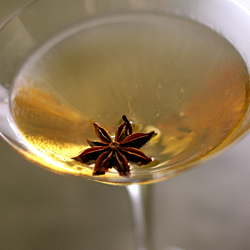 A month or so ago, at last unable to ignore the murmurs of delight circulating around the cocktail world, we sought out a bottle of Rhum Clément Creole Shrubb, an orange liqueur from Martinique. Made by infusing a blend of white and aged rums with spices and bitter orange peels, Creole Shrubb turns out to be quite different from the usual, more-neutral orange liqueurs. Its complexity intrigued us, but because we knew its dusky mysteriousness would make it an imperfect match for existing recipes, the Creole Shrubb languished on our “try me” shelf.
Last week, we received a bottle of Domaine de Canton, a ginger-cognac liqueur created by John Cooper (brother to Rob Cooper, creator of St. Germain) that has received a fair bit of positive press. As soon as I heard “ginger,” a light bulb went off in my head. Perhaps we’d finally found a companion for Creole Shrubb’s exotic overtones — and just in time for this month‘s fruit liqueur edition of Mixology Monday.
Creole Shrubb’s orange spice would be a natural match for the gingery Canton. Their families would get along, knit together by a shared history of tropical French colonialism: Creole Shrubb from les Antilles, Domaine de Canton with its roots in Indochine. Creole and Canton would fall in love and have beautiful little minibar bottles. Truly, I am the yenta of booze.

And yet, while the path to true love glowed ahead like a sunset on tropical shores, there was the danger this marriage of two sweet principals could become a sticky, sappy affair that would destroy itself in an explosion of pet names and babytalk. (“No, I wuv *you*, Cherie!”) Clearly, a sharp, antiseptic, perhaps even military chaperone was necessary — a no-nonsense personality to temper the flighty natures of our two romantics. I scanned the liquor cabinet and a grizzled naval officer stepped forward: Plymouth gin.
I must modestly admit that the first meeting of the three was a roaring success. I began by introducing them in equal amounts, reasoning that none would easily get the upper hand. These proportions turned out to be nearly ideal. When it seemed that the conversation could use a bit of lubricant, I blessed the vessel with a drop of bitters, and the addition brought the group together in even greater harmony.
Should you wish to arrange your own meeting, I have provided a guide below. If you must substitute, be prepared to tinker with the proportions. The penetrating sting of the Plymouth gin is especially (and surprisingly) important.




Asian Orange
1 oz Plymouth gin
1 oz Domaine de Canton
1 oz Rhum Clément Creole Shrubb
2 dashes Angostura bitters (or one dainty drop of Fee Brothers Whiskey Barrel Aged)
Combine in an ice-filled glass and stir until chilled. Strain into a chilled cocktail glass. Garnish with star anise, if desired.
Drink of the Week, drinks, Mixology Monday, recipes
8 Comments »
Posted by Cameron on 02.22.08 7:01 AM
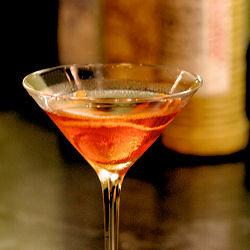 While trying to untangle the history of the Martinez, I started to feel like Jack Nicholson trying to get a straight answer out of Faye Dunaway in “Chinatown”. Built primarily from gin and sweet vermouth, the Martinez looks like the love child of the Martini and the Manhattan.
In the annals of cocktail lore, the Martinez is often cited as the parent of the Martini. Sister? Daughter? Both? Aw hell, Jake. I guess you can add cocktails to the list of things that get respectable if they last long enough.
Like many classic cocktails, the Martinez mutated over the years in response to changing tastes and available ingredients. Originally made with Old Tom Gin and a larger vermouth-to-gin ratio, the modern Martinez is a much drier tipple.




Martinez
— adapted from Gary Regan’s The Joy of Mixology
2 oz gin
1 oz sweet vermouth
2 to 3 dashes, or up to 1/4 oz Maraschino liqueur
1 dash bitters (typically Angostura, but Peychaud’s for an interesting variation)
lemon or orange twist
Combine liquid ingredients in cocktail shaker over ice. Stir until well chilled, and strain into a cocktail glass. Garnish with twist.
Drink of the Week, drinks, recipes
7 Comments »
Posted by Cameron on 01.04.08 7:03 AM
 It sometimes seems like Dean & DeLuca‘s mission is to curate the world’s most eclectic collection of foodie curios. A trip through the aisles of the Napa Valley outpost can feel like a visit to Ripley’s Believe It Or Not! museum (“Oh look! Salt-cured hummingbird tongues packed in oil from Madagascar!”).
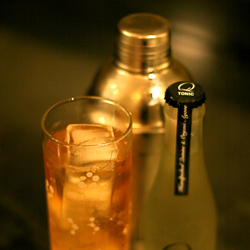
Of course, one of the great pleasures of cruising through such an outlandish assortment is that you occasionally run across something fabulous that’s incredibly difficult to find — like a bottle of Schweppes Indian Tonic Water. The regular Schweppes tonic is a staple in nearly every grocery store, but the drier Indian Tonic is all but unavailable in the States. Why the excitement? Until we sampled Fever Tree, I considered the rarely seen Schweppes Indian the sine qua non of tonic. Just as we grabbed a bottle from the cold case in order to see if was as good as we remembered, we spotted a 4-pack of Q Tonic, a newish brand that we’d heard of but not yet tried. Clearly the Fates had intervened, and another taste test was in order.
We set up the Schweppes Indian and the Q Tonic alongside a bottle of Fever Tree — the winner of our last tonic roundup — tasting each alone and mixed in a gin and tonic. Sweetened with glucose-fructose syrup and sugar, the Schweppes Indian tasted the most like the commercial American tonic waters, minus the nasty chemical aftertaste of high-fructose corn syrup. Its only drawback was a pronounced citrus finish that we found distracting. Next up, the Q Tonic had a light golden hue which may come from the agave syrup used as its sweetener. Bone dry, impossibly subtle, and with very little finish on the palate, the Q Tonic made for a somewhat flavorless G&T. If you’re tired of being bowled over by sugary, strongly-flavored tonic waters, you may enjoy the Q Tonic, but it left us unsatisfied.
Our favorite tonic remains the Fever Tree; we like the balance between bitter and sweet, the soft touch of cane sugar, and the occasional hints of spice.





After revisiting the land of quinine, it seems only fitting to propose a tonic-based beverage for Drink of the Week. But since we’ve already covered the Gin & Tonic, and the Tequila & Tonic — and given that we refuse to consider Vodka-Tonic an actual drink — it seemed like we’d run out of options.
Luckily, CocktailDB rode to the rescue. The Granada seems like an oddball combination, but it’s surprisingly balanced and quite refreshing. Its relatively low alcohol content makes it a good option for cocktail parties, or perhaps a post-chores refresher on those Saturdays when a cold beer just seems too heavy or malty. It’s zippy and a little spicy, and the quinine’s bite cuts through the sweetness of the orange liqueur while playing off its bitter-orange notes to a T.
Granada
1 oz brandy
1 oz dry sherry
1/2 oz orange curaçao (such as Cointreau)
Shake together with ice, and strain into an ice-filled highball glass. Top with tonic, and serve.
Drink of the Week, drinks, recipes
6 Comments »
Posted by Cameron on 10.15.07 7:02 AM
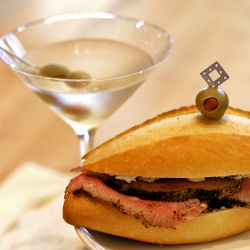 A big shout out to Natalie over at The Liquid Muse for choosing food/cocktail pairings as the Mixology Monday topic for October. My proposal for a decadent lunch (or bachelor’s dinner) is a steak and bleu cheese sandwich paired with an ice-cold Martini — one of my all-time favorite combinations.
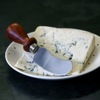
This is no tame, civilized snack. The sandwich should be rough and ready. You’ll need slices of cold beef left over from the loud debauchery at the grill Saturday night; a good, chewy roll; a wedge of bleu; plus a spreading knife and the guts to use it.
No lettuce. No mayonnaise. No mustard.
This particular Martini you want to be rippingly cold and (to borrow a winning concept from The Art of the Bar) made with Atomic Age proportions of gin and vermouth. Skip the orange bitters; you’ve already got a lot of flavors coming together.
Consume while watching a sporting match, taking in an action flick, or plotting your next corporate takeover.


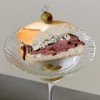
Steak and Bleu Sandwich
Cold sliced steak
Bleu cheese at room temperature
Chewy sandwich roll
Slice open roll. Spread several healthy swipes of bleu cheese on both halves. Layer bottom half with steak slices, and top with the other half. Eat.
 Atomic-Age Martini
2 oz gin
1/2 oz (or less) dry vermouth
Combine ingredients in an ice-filled mixing glass. Stir until icy cold. Strain into a chilled cocktail glass, and garnish with an olive or two.
drinks, meat, Mixology Monday, other blogs, recipes
6 Comments »
Posted by Cameron on 09.21.07 7:07 AM
 “The history of the world, my sweet;
Is who gets eaten and who gets to eat.”
— Sweeney Todd
We’re headed to the thyuh-tuh tonight for a performance of “Sweeney Todd: The Demon Barber of Fleet Street.” Here’s the short version: Crazy barber kills people, crazy restaurateur bakes them into meat pies, hilarity ensues.
I’ve loved the show since I first heard the music as an impressionable youth. How can you not like a musical with a showstopping number that muses about how different people would taste if you served them wrapped a tender, flaky crust?
While you digest that macabre notion, here’s a little something to wash it down. We’ve tinkered with the recipe a tad, but the name and the basic ingredients are original.





Sweeney’s Cocktail
1 1/2 oz brandy
1/2 oz pineapple juice
1/8 oz Maraschino liqueur (or to taste)
1/4 to 1/8 oz lemon juice
3 dashes Angostura bitters
Shake all ingredients well with ice. Strain into a chilled cocktail glass. Garnish with lemon twist, if desired.
Drink of the Week, drinks, literary, recipes
12 Comments »
Posted by Cameron on 09.19.07 11:49 AM
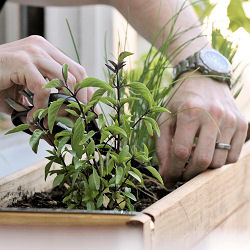 Like we needed more herbs.
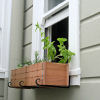
Seriously, we’ve got thyme, rosemary, and oregano in the yard (and by the yard), probably the three most useful fresh herbs to have within easy clipping distance. Adding to that could be viewed as extravagance, piling on, perhaps even hubris. So why do we have a window box outside our breakfast room sprouting green leaves and stalks?
It all started in July with a bunch of sweet basil that Anita brought home from the farmer’s market. She used what she needed and stuck the rest in a glass of water on the kitchen windowsill, where we ignored it for two weeks. We must have added water at regular intervals, because the glass wasn’t all that big, but I don’t remember doing it or seeing Anita do it. It got less attention than a bald white guy at a dim sum parlor.
Darned if that bunch of basil didn’t grow roots and stay all green and lush and everything.
So about the time that we’re watching these stalks get their groove on in about a cup and a half of Hetch Hetchy’s finest, we start thinking that the view out the window of our breakfast room is a little stark. Which is not exactly a penetrating observation given that the window faces an expanse of painted plywood about eight feet away. This was also right about the time when the main garden was popping along in full summer bloom, and I was thinking that maybe I could see a faint tinge of green around the edges of my thumbs. Yes, even after I washed them. Smartass.
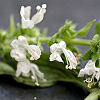
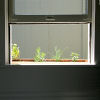
Anyway, I figured that if we gave this little survivor of a basil plant some dirt and a little love, we’d really see something. At the same time, a window box would be just the thing to spruce up the view. So I split the bunch of basil in two and planted half down in the yard near the bergamot tree. The other half I put in a window box along with some tarragon, chives, and Thai basil.
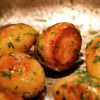
So far, the box has succeeded both as a still life and a food source. A little bit of the tarragon goes a long way, but it gave the sauteed potatoes that we made for our Julia Child dinner just the right touch. The chives have made cameo appearances in several dishes (including those same potatoes), and the Thai basil dropped in on one of our standby stir-fries last week.
The basil is still growing, but slowly; it’s a living demonstration of how my enthusiasm for gardening occasionally outstrips any calculations of practicality. As I’ve discovered, basil isn’t generally the sort of thing that you just pick a leaf or three off now and again. If you’re serious about consumption, you grow it in big bunches for regular harvest.
But honestly? I really don’t care. I know that I’ll have to plot (heh heh) and plan if I want to try a real vegetable garden… even a small one. In the meantime, it’s a thrill just to plant something green and watch it thrive. It feels like a promise that I’m making to myself.
Pommes de Terre Sautées
adapted from Mastering the Art of French Cooking
2 pounds “boiling” or new potatoes
2 T butter plus 1 T oil, for sauteeing
2 to 3 T softened butter
1/4 tsp salt
2 to 3 T minced fresh green herbs (parsley, chives, tarragon)
Peel the potatoes. As you do, try and make them as smooth as possible and give them an oval shape that may remind you of extremely large olives or impossibly small rugby balls, depending on how you spent your formative years. Do not wash the potatoes after peeling; pat them dry with a clean towel. If you need to hold the raw potatoes for a while before you cook them, wrap them in a damp towel, and then dry them before cooking.
Add the butter and oil to a skillet and heat it over medium high. When the butter stops foaming, put the potatoes in and leave them for two minutes. Control the heat so that the butter/oil mixture stays hot but does not color. Shake the potatoes in the skillet, rolling them around and letting them sit to sear until they are pale gold all over.
Sprinkle the salt over the potatoes, lower the heat, cover the skillet, and cook the potatoes for 15 minutes, shaking them every three or four minutes to prevent sticking. When the potatoes yield to slight pressure from your finger or when a knife pierces them easily, use the skillet cover to hold in the potatoes while you pour off the fat.
Take the potatoes off the heat, add the softened butter, herbs, and a few grinds of fresh black pepper. Shake the potatoes in the skillet so that they glisten with herbs and butter. Serve immediately.
cookbooks, garden, recipes
4 Comments »
Posted by Cameron on 09.07.07 7:13 AM
 We spend a fair bit of time thinking about fun things to put in cocktail glasses. We like filling them ourselves, and we like finding places where they arrive before us brimming with tantalizing, aromatic mixtures. But while we’ve written about liquors, liqueurs, bitters, and more, we’ve yet to address water, an indispensible part of an enjoyable cocktail experience.
We think about water in very different ways than we used to. It’s easy to forget that not long ago (when Lionel Ritchie danced on the ceiling), Evian and Perrier were truly snooty stuff. Today, even the most benighted grocery store offers multiple brands of still and sparkling water.
Bottled water is often more readily available than tap, and it occasionally solves real issues of quality or sanitation. Anita’s mom lives just outside of Las Vegas, where she buys drinking water by the five-gallon jug at one of the area’s ubiquitous water stores. (Yep, that’s all they sell.) We’re glad that she does, as the local tap water laughs at Brita filters and tastes like it came from an ill-kept swimming pool.
But many geographic regions have seriously good tap water, and local water is even an irreplaceable recipe ingredient. In these areas, bottled water provides convenience or a perception of higher quality, but comes with with a true pricetag we’re just starting to appreciate. Why, when we’re counting our food-miles, watching our carbon footprint, and supporting area farmers by buying local meat and vegetables, are we washing it all down with water that has been shipped from Europe? This question has prompted several Bay Area restaurants to switch from bottled water to municipal water that they refilter — and sometimes even carbonate — themselves.
Carbonation, of course, generates that delightful addition that you can’t get from the tap: bubbles. The carbonation machines used in restaurants are large and expensive — out of reach of most private citizens. But supplying your maison with local eau gazeuse is achievable. If you live in or near a city, you may be within range of a service like the Seltzer Sisters, which jacks up good old Hetch Hetchy with fizz and delivers it in reusable plastic seltzer bottles. If you have a hardcore DIY streak, you can find surprisingly detailed plans for building your own carbonation system. Or, you can buy a soda siphon and charge your own seltzer. (In the interests of full disclosure, our own siphon adventures have been less than successful; your mileage, as they say, may vary.)
No matter where it comes from or how it got there, water can make or break a single cocktail or an evening’s indulgence. Soda water is a common mixer, and ice cools and tames a drink’s ardent spirits — some even feel strongly about the very shape and clarity of the ice that does the job.
But for all that, the water that we appreciate most when we’re at a bar is stuff that arrives alongside our cocktails. Presuming that it doesn’t taste like a Vegas swimming pool, our requirements are simple: water should be available immediately and continually. We do our level best to drink at least one full glass for each cocktail. Providing ample water is one of the surest signs of a thoughtful bartender; staying hydrated is the best way we know of to avoid a painful sunrise.




Dressed-up Tap Water
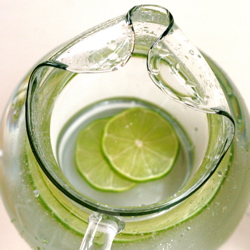
Even if your area enjoys pleasant-tasting tap water, a quick preparation before your next dinner party can add a bit of grace to your table. Fill a pitcher with water and put it in the refrigerator to chill. An hour or so before your guests arrive, float a few slices of citrus or cucumber in the water to give it a little extra flavor. You can leave the citrus slices in the pitcher when you serve, but it’s best to pull the cucumber out, as it can become waterlogged and unattractive.
bar culture, Drink of the Week, drinks, entertaining, locavore
8 Comments »
Posted by Cameron on 08.14.07 9:58 PM
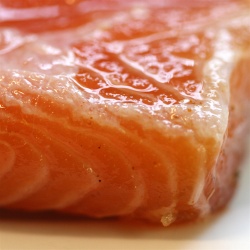 Sometimes, my palate is a live illustration of the law of unintended consequences. The combination of our sausage-making party and the constant talk about preserving food that comes with summer rattled around in my subconscious for weeks.
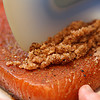
Then, on a Saturday morning as we did our shopping, we passed by Shogun Fish at the market. They were advertising the first local wild salmon of the season and a relay closed somewhere in my head. Suddenly, I wanted gravlax, and I wanted to make it myself.
On the hunt for a recipe, I turned to Tom Douglas’ Seattle Kitchen. Tom is my first stop when I need wisdom about salmon, and his advice mostly lined up with other recipes and random commentary that I found around the InterWebs. I guess. The big differences were the addition of ground juniper berries (possibly traditional) and the absence of dill (definitely untraditional), and the presence of some other spices.
Fennel? Cayenne? Okay, whatever.
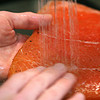
In theory, I knew that the process wasn’t difficult: just a simple salt/sugar cure. But I had no idea how dead-freakin’-easy it would be. Just pack the dry cure over and around the fish, weight the whole pile down with cans or what-have you, refrigerate, wait a few days and POW! Instant gravlax. Seriously, the hardest thing about this whole project was picking the juniper berry flecks out of the finished product. Obsess much? No! Yesssss. (Who said that?)
I love this stuff. I eat it for breakfast — with soft scrambled eggs, yum — for lunch, for a snack, whenever. For my next batch I’m going to try vacuum-sealing and freezing some to see how it holds up.

Gravlax
1-1/4 pound salmon fillet, preferably skin on, pin bones removed
Cure
2/3 cup kosher salt
2/3 cup granulated sugar
1/4 cup firmly packed brown sugar
1 1/2 teaspoons paprika
1 teaspoon ground juniper berries
1 teaspoon fennel seeds, ground
1/4 teaspoon cayenne
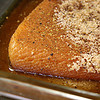
Combine the cure ingredients in a small bowl. Sprinkle the bottom of a non-reactive baking pan with about 1/2 inch of the cure and place the fish in the pan, skin side down. Blanket the fish with the remaining cure, creating a layer about 1-1/2 inches thick.
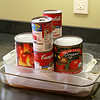
Cover the salmon with a piece of wax paper and top with another smaller pan, then weight the top pan down with a few cans. Store in the refrigerator for two to three days until the salmon is quite firm to the touch; the exact amount of time will depend on how thick your piece of salmon is. Remove the wax paper and the cans, and then use a rubber spatula to scape the cure from the salmon. Remove the salmon from the pan and briefly rinse it, then pat it dry with paper towels. To serve, slice the gravlax very thinly on the bias.
Cook’s note: I was not shy at all about rinsing the gravlax under cold running water until the cure was gone, daddy gone.
breakfast, meat, preserving & infusing, recipes
5 Comments »
Posted by Cameron on 08.06.07 10:28 PM
 Okay, honest, I never intended for this garden tour to become a summer-long thing. I started in June, figured that I’d post a few times and be done by early July. Now here it is August already. Where do the days go?
For those of you just joining us, this is the third installment of a tour of our backyard, which we reclaimed from ugly ignominy just over a year ago. In our last episode, we braved the Northside Fruit Preserve and the Eastern Wall. What adventures lie ahead?
On the south side of the yard, we see the fence that separates the garden from the dog run. Until mid-June, it was blanketed in passion fruit vines that seemed like a good idea when we planted them. However, “fast-growing and aggressive” does not begin to describe these guys. After only a single year, two plants completely covered a 25-foot fence and needed to be trimmed practically every day. After being grimly and colorfully assured that we hadn’t seen anything yet, we decided to eliminate the vines before they ate one of the dogs.
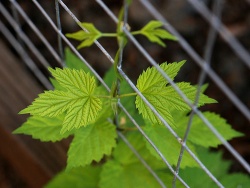
However, we’re not sure that we haven’t forsaken the frying pan for the fire. In the place of the passion fruit, we installed four Golden hop vines purchased from the farmer’s market. We’ve always wanted to grow hops, but have never had the motivation, garden space, season, and rhizomes come together at the same time. Planted in late June, the hops have already enthusiastically twined through the fence and are waving feelers around above the rail line. But for some reason, I feel more kindly toward these particular fast-growing, aggressive vines than I did the passion fruit.
Theoretically we could use the hop flowers to make beer, but it’s more likely that we’ll take the advice a passerby at the market gave us as we were buying the plants. Apparently, hop-shoot risotto is a done thing in some parts of Italy (and elsewhere?). If you have any recipes, please share!
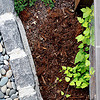
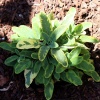
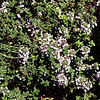
In front of the south fence, we have line of herbs (two thyme plants, one oregano, and one sage plant) that define the most serious, working part of our garden. We’re down there clipping fresh bits for cooking at least once a week. Our herb crew has battled through adversity: the oregano fell prey to a mite infestation last year, and our original variegated sage plant died shortly after it was planted. But the oregano has come bounding back, and we recently replaced the sage. Everything is growing like gangbusters, especially the thyme.
The fact is, “growing like gangbusters” describes everything that we’ve put in — a state of affairs that I attribute to the gentle microclimate that favors our patch. When we originally planned the yard, I chose plants that would produce food, but that wouldn’t require much tending. But now, flushed with success, I’ve found myself contemplating a true vegetable garden. A small one, mind you.
In the meantime, the sun is out, and there’s a chair on the patio near the magnolia with a good book and a tall, cool glass of something refreshing waiting for me.


garden
4 Comments »
