Posted by Anita on 10.26.07 7:04 AM
 Despite its spooky name and eerie orange glow, Satan’s Whiskers is not the least bit diabolical. Unlike many vintage cocktails that shape-shifted their way across the decades, this drink’s somehow kept its original form throughout time.
Both the Savoy Cocktail Book and Patrick Gavin Duffy’s Official Mixer’s Manual call for equal parts gin, sweet vermouth, dry vermouth, and orange juice, plus half as much Grand Marnier as gin, and a dose of orange bitters. Some sources call for equal parts of all the ingredients and a dash of bitters; others hew to a half-measure of liqueur and also decrease the juice.
Truth be told, there’s more variation to be had from using different brands of vermouths (especially the sweet varieties) than any of these minor tweaks will afford; we like the flavor of Cinzano Rosso best, both on its own and mixed in the Whiskers. We used Sarticious gin — yet another local liquor, distilled over the hill in Santa Cruz — but any straightforward dry gin will do the trick.
Being great lovers of compromise, our recipe below is mostly Savoy, with a little extra bitters. If your liquor cabinet lacks Grand Marnier, you can substitute orange curacao for a variation known as “curled”. And if autumn’s chill gives you a craving for dark spirits, you might follow the lead of our friends at the Zig Zag Cafe, who make a delicious alternative dubbed Satan’s Soulpatch, replacing the gin with bourbon.





Satan’s Whiskers (Straight)
3/4 oz dry gin
3/4 oz sweet vermouth
3/4 oz dry vermouth
3/4 oz fresh-squeezed orange juice
1/2 oz Grand Marnier
2-3 dashes orange bitters
Shake all ingredients with ice; strain into a chilled cocktail glass.
For Satan’s Whiskers (Curled): Substitute orange curaçao for the Grand Marnier
For Satan’s Soulpatch: Substitute bourbon for the gin

1 year ago: Corpse Reviver #2
Drink of the Week, drinks, recipes
5 Comments »


Posted by Anita on 10.23.07 1:37 PM
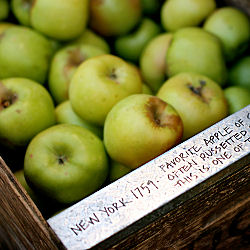 When I think about the bloggers participating in the Dark Days Challenge in places like Maine or Minnesota or Michigan — places where winter actually involves snow, frost, and farmers markets that close for the season — I feel like a fraud.
We still had tomatoes at our market this weekend — heirlooms and Early Girls and a rainbow of Sweet 100s — from a surprising number of farms. They sat there in their little cliques, cozying up to their buddies, red peppers and basil. You could almost imagine them standing in front of a mirror inspecting their own summery plumpness and silently mocking the homespun pumpkins and Brussels sprouts on the next table over.
Frankly, I’m over these cheeky girls of summer. I’m ready for the potatoes and the greens and the crisp new apples. It’s a little eerie to realize that I could eat today the same meals we made in June without even leaving the market. I even saw three different vendors who were still selling strawberries… they’ve been on the farm tables since the first week of April, for goodness sake. I’ll be sad when the pasture-raised chickens come to an end, but that’s really all I’m going to miss from summer. Autumn is my favorite eating season.
 We started out our Dark Days Challenge last week with some of our favorite standbys. We make these dishes a lot, and we’re pretty dialed in on where to find their ingredients from local sources. And I suppose that’s one of the benefits of eating locally all the time: With the exception of farmers dropping out of your market, you pretty much know where to find your favorite things, after a while. You also know, eventually, what’s hard (or even impossible) to find; it makes you more alert when you spy something you haven’t found locally before.
Speaking of which, our friend Cookie turned me on to a local source for wheat flour and polenta. Although Full Belly Farms is about 100 miles away, they don’t come to my local market — they sell at weekday markets in places I can’t get to during the workday, plus one Saturday market down in Palo Alto, 30+ miles south of us. So now I get to make the choice about whether it’s better to drive an hour to buy the local option, or stick with my carb exemption. The other good news is that I found out (from Cookie, again) that the white rice we’ve been buying is harvested semi-locally… about 150 miles away.
Here’s what last week looked like:
Chicken & Dumplings
– Marin Sun Farms chicken; onions, carrot, celery from the market; garden herbs
– biscuit mix from Beth’s in San Rafael; Clover Organic milk
Chili Dogs (can’t watch the playoffs without ‘dogs!)
– Prather Ranch uncured hotdogs and Acme pain de mie buns
– Chili made with our own tomato sauce and homemade pork sausage, plus Prather chuck
– Eatwell Farms onions, and non-local (but organic) cheese
Oxtail Ragu and Pasta
– Marin Sun Farms oxtails braised with our own chicken stock and tomato sauce
– salad: red-leaf lettuce (Little), avocado (Will’s) and tomatoes (Everything Under the Sun)
– non-local dried orecchiete pasta
Pork & Potatoes
– Double-cut Prather Ranch pork loin chop on the grill
– Roasted Iacopi Farm brussels sprouts with Bariani olive oil
– Roasted ‘rose Finn apple’ potatoes from Mr. Little
Pasta (Not-Quite-)Bolognese
– meat sauce made with Prather beef and pork, Mariquita tomatoes, Eatwell onions
– garlic bread: Clover Organic butter, Acme rolls, local garlic
– non-local dried pasta




farmers markets, locavore, other blogs
10 Comments »
Posted by Anita on 10.19.07 7:02 AM
 Last weekend, Cameron and I spent the better part of our monthly cocktail budget on a pair of tickets to the Independent Spirits Fest. Although my mom thought it sounded like the kind of groovy gig where you’d follow your bliss, it’s actually a trade show for distillers who aren’t aligned with any of the booze juggernauts.
One of the best Fest perks was the opportunity to taste a number of liquors you can’t easily put your hands on, either because they’re too rare (often combined with “too pricey”), or too new to find in stores. With more than 30 exhibitors filling two small conference halls, we decided to focus on those near to our heart: Folks making booze in Northern California.
Between us, we tasted 20+ locally-produced items from a dozen different producers over the course of the evening. (Don’t worry: Most ended up in the spit bucket, and we took a cab home.) Some names you’d recognize from the shelf of your local bar, like Junipero gin and Hangar One vodka. But many new-to-us discoveries — like St. George’s lovely single malt, a bierschanaps made in Mountain View, and Charbay’s haunting pastis — were almost worth the cost of admission.
Best of all, it was a treat to find so many liquors produced within 100 miles of our home bar. Of the major booze families, I think we’re really only lacking a local American-style whiskey (one’s coming soon from Pioneer Spirits in Chico, with any luck) and a tequila equivalent, which can only be a matter of time given the mezcal explosion and the Bay Area’s love affair with agave.
But even after Wednesday’s Dark Days post, I can’t say that we’re going totally loca-boire. I think it’s safe to say, however, given the diversity of what we found — gin, whisky, rum, vodka, brandies, eaux de vie, liqueurs of all sorts — you’ll start seeing a lot more local products on our shelf, and on the blog.
—-
But on to this week’s drink: I’d been playing with honey drinks for a while, but it wasn’t until I sat down with my brand-new (to me) copy of David Embury’s classic The Fine Art of Mixing Drinks that I found one that really appealed to my tastes. Early in the book, Embury holds forth on the dark days of Prohibition and the birth of a number of “pernicious” cocktails, including a concoction christened the Bee’s Knees — equal parts honey, lemon, and gin. Thankfully, the days of bathtub gin are long behind us, and the modern version of the drink (which Embury endorses in later chapters) calls for saner proportions.
The glorious thing about the Bee’s Knees — which fully lives up to its name — is that it’s another one of those drinks you can easily make with ingredients you keep around the house. And, if you’re lucky like us, even with ingredients grown or distilled within a few miles of home. Careful observers will note it’s a close relative of the Whiskey Sour, and it shares that drink’s easygoing ways.
Although they weren’t exhibiting at the Fest, our favorite white liquor these days is sassy 209 Gin, distilled along the San Francisco waterfront at Pier 50 (a full 6 miles from our door, if you’re counting). It’s a lovely, mixable spirit, well-balanced but spunky.
The honey we get from Meeks’ in Soquel (72 miles) is fairly solid stuff. To bring it to a spreadable consistency, we usually warm the jar in a small saucepan of water. Alas, that’s not such a clever idea when mixing drinks: Hot honey isn’t exactly conducive to a crisp and cool cocktail, and it seizes back up as soon as it hits the ice. The problem’s easily remedied by using honey syrup: Heat equal parts honey and water in a pan, stir until dissolved, then pour into a bottle for storage (in the fridge, please).
Last but not least, there’s lemon juice. Although local honeybees are big fans of our backyard Meyer lemon tree, its current crop of fruit isn’t quite ripe. Luckily, a number of the farmers at the Ferry Building market keep us well supplied with Eureka lemons. In a few weeks, when our lemons turn yellow at last, this drink’ll get about as local as can bee.





Bee’s Knees
2 oz dry gin
1 oz lemon juice
1 oz honey syrup
Shake all ingredients with ice, and strain into a chilled cocktail glass.
———-
Drink of the Week, 1 Year Ago: Moscow Mule
Drink of the Week, drinks, locavore, recipes
17 Comments »
Posted by Anita on 10.17.07 7:35 AM
 So many variables factor into the bounty of the Bay Area’s foodshed: The density and affluence of our population creates a bumper crop of food-obsessed consumers, our progressive social milieu fosters an interest in sustainability, and the richness of our restaurant scene rewards ambitious farmers.
But underneath all that is the inescapable fact that we live in one of the most fertile food-growing regions in the country. Add to that an eye-crossing number of microclimates, and the result is an astounding variety of warm-weather crops from just-spring to deep autumn. Even in winter, our markets offer an almost unbelievable abundance.
I know that most other regions don’t have it so easy; reading the seasonal posts of other food bloggers brings that fact home. Eating locally, especially year-round, can be a struggle for even the most dedicated fanatic. In most areas, the first frost pretty much spells doom for the locavore agenda, save for home-preserved harvests, hardy winter crops, and often-pricey meats and cheeses.
So when I read on the Eat Local Challenge blog that an autumn-into-winter locavore event was afoot, I had to check it out. Laura — who writes a charming blog called Urban Hennery out of Everett, Washington — is blogging her latest experiment: Feeding herself, her husband, and her friends on local foods throughout the remainder of the year. She’s challenged anyone interested to join her, christening the event the Dark Days Challenge.
I signed on with Laura without giving the idea much thought… without realizing that this snap decision means we’re going to become a lot more candid about the choices we’re making when we shop. This isn’t just a one-week flirtation with locavore exhibitionism, as we’ve done before. But I know we can do it because it’s what we’ve been doing pretty much all summer long, on the sly. And, honestly? Not doing it here — in what must be the easiest place in the country to attempt this challenge — would feel churlish.
My name’s Anita, and I’m …a locavore. There, I said it.
All joking aside, I’ve been bashful of talking about what we’re doing, mostly because I am leery of sounding sanctimonious or self-congratulatory. Food choices are incredibly personal, and if you have strong opinions about what you eat and why, it can be hard to talk about them without seeming snobbish. Or condescending. Or egotistical. Or just vain.
So, in order to salve my fears, I’ll say this and then trust that you’ll give us the benefit of the doubt: Eating sustainable, local, and organic food whenever possible is important to us. But by sharing what we’re doing, we are in no way condemning anyone else’s choice.
Enough of that, and full speed ahead. We’re on this bandwagon for the full ride. Expect to hear about our locavore adventures — the triumphs and the challenges, as Laura says — throughout the fall. We’ll continue to eat as locally as we can as often as we can, and write about it at least once a week until New Year’s Day.
Laura has encouraged her Dark Days cohorts to modify the house rules to suit their circumstances. Based on our experience in past challenges, we’ve held ourselves to a harder line with some items (like produce miles) and taken a more realistic approach to others (like carbs). Here’s our general game-plan:
- We will continue to cook locally as often as we can, with a baseline of two dinners per week made from 90% local ingredients.
- We will write about at least two meals a week made with as many local ingredients as we can source.
- Local for us will be a 100-mile radius for produce and a 200-mile radius for protein. Strong preference will be given to items purchased direct at the farmers market rather than retail.
- We’re making the usual ‘Marco Polo’ exemptions for seasonings. We’re also making exceptions for flour, dried pasta, white rice, and polenta — we have no local sources of these ingredients, and man does not live by potatoes and bread alone. We will try to source baking ingredients locally, but I don’t expect to find much beyond nuts, and I won’t go through the holidays without baking.
- We’ll try to limit processed foods to those produced within a 50-mile radius. We’ll try to determine how much local ingredient sourcing they’re doing, and talk about it in our posts.
- We’ll continue with the challenge through the end of the year, and then re-evaluate on New Year’s Day along with other participants.




locavore, other blogs
8 Comments »
Posted by Anita on 10.16.07 12:02 PM
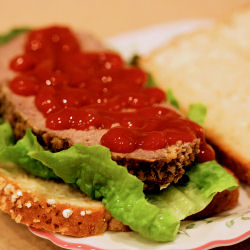 You learn the darndest things when you blog.
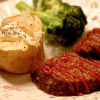
Here’s just one example: Until a few days ago, I never knew that one of my all-time favorite foods was so widely appreciated. I mean, I knew meatloaf sandwiches were something other people ate, but I had no idea they loved them as much as I do.
That is, until the day I posted this photo on Flickr and the comments started rolling in:
“One of the best uses of leftovers of all time.”
“Nothing better [than a meatloaf sandwich].”
I’m right there with them. I may love meatloaf sandwiches even more than I like the original meatloaf dinner. Which is impressive, considering my adoration for baked potatoes knows no bounds.
For those of us in the meatloaf-sandwich-lovers clique, there’s no need to wait for a special occasion to celebrate. But in case you’re seeking an excuse, Serious Eats declared this Thursday National Meatloaf Appreciation Day, and we’re all invited to play along.
Don’t tell me that you don’t have a prized family recipe to bring to the party? Oh, you poor thing. Here… pull yourself together. Sit down and let me give you a copy of ours.
But first, a few caveats:
Our family meatloaf is a bit of an anomaly. It doesn’t come topped with pan gravy, or even a tomatoey glaze. (Although Heinz ketchup is a mandatory condiment, as far as I’m concerned, it’s absent from the cooked dish.) This recipe also eschews breadcrumbs as a binder; Quaker Oats serves that purpose. An unorthodox choice, to be sure, but the end result is less bizarre than you might expect.
In place of the usual middle-American seasonings, our meatloaf features some strange-sounding spices. Happily for any purists among us, they fly under the radar, adding their warmth without making anyone think of an oatmeal cookie. Perhaps the biggest heresy of all: This meatloaf isn’t baked, or even shaped, in a loaf pan. Sporting the freeform curves of a football (make that ‘rugby ball’ outside the US), our odd-shaped loaf maximizes the crusty edges our family covets.
And because the resulting slices are just a teeny bit wider than the average piece of bread, the elliptical shape yields some delicious trimmings — perfect nibbles during the next day’s sandwich-making activities. Lucky you.


Mom’s Meatloaf
1-1/2 pounds ground chuck
1/2 pound pork breakfast sausage
1 onion, grated
1 egg
1 cup uncooked oatmeal (not instant)
1/4 cup milk
1 tsp salt
1/4 tsp ground black pepper
1/2 tsp nutmeg
1/2 tsp allspice
Preheat oven to 350°F. Combine all ingredients in a large bowl until well mixed. Pat into a football shape and place in a wide baking dish or a small roasting pan. Bake for 75 minutes, or until juices run clear when the center is pierced with a knife.
family, meat, other blogs, recipes
12 Comments »
Posted by Anita on 10.12.07 10:57 AM
 Las Vegas is perhaps the last place on the planet you’d expect to find anyone attempting to practice the locavore lifestyle. It’s the kind of city, after all, where restaurants brazenly tout their ‘locally caught salmon’ knowing full well that the closest ocean lies more than 300 miles away. (Perhaps they’re secretly stocking Lake Mead with King and Chinook?)
But the evidence that times are a-changing is there in black and white: Wednesday’s Review-Journal Living section featured a front-page story on chefs seeking out local purveyors and farmers attempting to create a market for their produce. To my surprise, a fair number of crops are grown within an hour’s drive of Sin City, just over the hill in Pahrump — a town better known for its ‘chicken ranches‘ than its vegetable farms.
And there’s more good news, quite literally just over the horizon. Although the Las Vegas Valley’s extreme temperatures — well over 100 in the summer and occasionally below freezing in winter — make large-scale farming nearly impossible, the nearby valleys of Southern Nevada can support a wide variety of carefully selected crops. Although water-intensive fields of alfalfa and grain are out of the question, the article points out that water-conscious drip irrigation (much like the kind we use in our own mini-orchard) is particularly well-suited to food crops grown for humans, rather than livestock. The UNLV cooperative extension specialists are working with folks interested in raising “everything from natural beef and pheasants to vegetables and fruit”, right within shouting distance of the neon and nightlife.
It’s a fascinating article about a region in transition. One only hopes they gain some traction before the local housing boom puts pressure on farmers to sell out to developers of yet another slapped-together townhouse pod.
The story arrived too late for me to explore many of its finds — the lone retail farmer mentioned operates a stand only from June through September. But I’m ecstatic to read that Whole Foods has her farm, and presumably others like it, under contract for next year’s harvest. The last time I was in town, just months ago, the local Whole Foods in Henderson was trucking in every last apple and avocado they sold all the way from our very own Central Valley. Most of their produce had travelled almost as far as I had, and some even hailed from another hemisphere. I suspect we have Michael Pollan to thank for this radical change, for holding Mr. Mackey’s feet to the fire.
—–
You can even find backyard edibles from green-thumbed gardeners making the most of their fickle surroundings. Some Asian friends have a few makrut lime trees, and another grows cilantro so prolifically that she can share giant batches with her friends. The neighbor up the hill has wide-paddle cactus along his fence; I doubt he’s making nopales, but we do see him harvesting tunas with a pliers now and then. (Let’s hope he’s making Margaritas with the juice.)
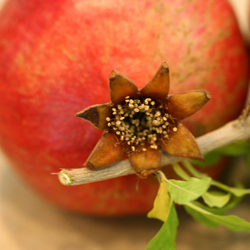
But although you might expect to find edible cacti among the sand and sagebrush, the desert is full of other surprises. On my last full day in town, Mom’s friend from across the street arrived bearing a pair of picture-perfect pomegranates from her own backyard. It’s one of those smack-your-forehead discoveries: These seedy fruits hail from the Middle East, so they’re well-adapted to dry desert climes. The ones grown just feet from our front door were large and beautiful; they weren’t as sweet as the cultivated variety, but they would make a delightful addition to a winter salad or a garnish for chiles en nogada.
Next time, we’ll have to put aside the casseroles and meatloaf for one night, and see where the desert leads us. Perhaps by then, even Whole Foods will have made good on its agenda, and ‘local Southern Nevada produce’ might no longer be an oxymoron.
locavore, Vegas
5 Comments »
Posted by Anita on 10.12.07 7:09 AM
 I distinctly recall the first time I drank a Whiskey Sour. Our friends Jason and Maggie, eking their way through grad school, lived in East Palo Alto (pre Four Seasons, pre Ikea). Their apartment sat tucked behind a bungalow facing the 101 frontage road. The neighbor who lived in said bungalow was an affable fellow named Drew, a long-haired techie, musician, and tinkerer. The bungalow inevitably became the scene of numerous jam sessions: late-night sing-alongs fueled by a potent mixture of whiskey, powdered sugar, ice, and the juice of the Meyer lemons that grew right outside Drew’s kitchen window… all whizzed up in the blender. (Hey, we were young.)
Like the Cape Codder and the Gin & Tonic, the Whiskey Sour is one of those highly adaptable libations that can be successfully concocted nearly anywhere. The lemon juice puts it a bit beyond the reach of the average hotel minibar, but anyone with access to an airport lounge, a rural grocer, or a even a half-decent convenience store can enjoy a respectable version without much fuss.
Depending on your personal palate and your choice of whiskey — in deference both to old memories and my mom’s limited provisions, we brought out the Beam — do vary the amount of simple syrup. Canadian, bourbon, blended, even rye… they’re all fair game here. Our bottom-shelf version, complete with a WalMart nuclear cherry on top, was perfectly fine; I can hardly wait to mix one up with the good stuff when I get home.





Whiskey Sour
1-1/2 oz fresh lemon juice
2 to 2-1/2 oz whiskey
1/2 to 1-1/2 oz simple syrup
lemon wedge and cherry for garnish
Shake the juice, whiskey, and syrup with ice; strain into a chilled sour glass or rocks glass. Garnish with the lemon wedge and cherry.
Drink of the Week, drinks, recipes
7 Comments »
Posted by Anita on 10.11.07 5:12 PM
 The lovely and talented Jennifer of Last Night’s Dinner challenged me to divulge the five foods that I’m ashamed to love. After chewing on this meme for nearly two weeks, I have a confession to make: There aren’t a lot of foods I’m embarrassed about anymore.
Some of my former foibles have fallen by the wayside. After reading up on the delightful ingredients in my once-beloved Fresca — what the hell are ‘brominated vegetable oil’ and ‘ester of wood rosin’ doing in my soda pop? — I’ve managed to get that particular grapefruit-flavored monkey off my back.
There are plenty of foods that I like that other people find amusing. I take a fair bit of good-natured ribbing about the frequency of my macaroni salad consumption, but it’s hardly the stuff of blushes and stammers. Sure, there’s a slight bashfulness about my regular indulgences in cheesy Mexican combo plates …but I eat enough of the real stuff that I can accept my fondness for the less-authentic version as a regional quirk. I’ve made peace with my unholy love of canned corned-beef hash, and even found a few foodie friends who share my tragic attraction to the pink cylinder of doom. But even this, the worst hyper-processed dreck of the lot, I wear as as a badge of my eclectic taste rather than anything I’m actually trying to hide.
But there is one food I’m just a wee bit embarrassed to love: Casseroles.
When we were kids, Mom always managed to make fabulous dinners on a slim budget. Our evening meals were never gourmet (that was Grandpa’s turf), but they always tasted great. Shake-n-Bake chicken with rice, meatloaf and baked potatoes, even the occasional steak on the grill… we must’ve been the only kids on the block who didn’t have to be coaxed to clean our plates. One-dish suppers were the mainstays of our family diet: Mexican lasagna, a pair of tuna casseroles — one with curried rice, another simply called “That Tuna†— and the frankly named Oven Put-Together. But the queen of them all, the one I still crave, was a homely little dish called Creole Rice.
Much like so many of the faux-ethnic dishes of 70s, there’s not much ‘Creole’ about this mélange. (I suppose it’s slightly more authentic than the disgusting-sounding ‘Thai’ Pepper Salad that my friend Michael recently dredged up. Secret ingredients: Bulls-Eye BBQ Sauce and Miracle Whip…). And while we’re being honest, Creole Rice is definitely one dish that won’t win a single beauty contest — it’s about as beige as can be.
But it’s comfort food in the extreme, at least for my family, and Cameron eats it without too much smirking. I jokingly call it Trailer Park Paella (though it’s closer to Redneck Risotto), but that doesn’t stop me from hauling out the old recipe card a few times a year. Still, that red-and-white can of Campbell’s cream of chicken soup lurking in the dark recesses of our pantry was cause for more than a little locavore angst.
Inspired by The Homesick Texan’s recent post about revamping her hometown favorite, King Ranch Chicken, I decided to see if we might be able to remove the store-bought gloop from good ol’ Creole Rice without losing its homespun charm. Given that the soup was really the only scary ingredient, it wasn’t terribly hard; if you use homemade breakfast sausage, you can probably even make it entirely with local ingredients.
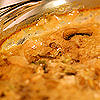

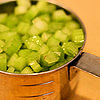
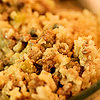
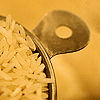
Creole Rice Redux
2T salted butter
2T flour
3 cups chicken stock
1/4 tsp black pepper
1 cup sour cream
1 pound pork breakfast sausage
8 to 12 oz white mushrooms, sliced
1 cup diced celery
1 cup diced onion
1 cup uncooked long-grain rice
Preheat the oven to 350 degrees F.
Melt the butter over medium heat in the bottom of a large saucepan, then add the flour. Whisk continuously until the flour browns slightly — you’re looking for a blonde roux. Add the chicken stock and bring to a boil; reduce heat and simmer for a few minutes until it reaches a thin but sauce-like consistency. Add the pepper and taste for seasoning, adding salt and more pepper if needed. Remove from heat and stir occasionally until warm but not hot. When cooled a bit, add the sour cream and stir until well combined.
While the sauce cools, sauté the pork sausage until browned, crumbling into small chunks. Remove the sausage from the pan with a slotted spoon, and place in the bottom of a large casserole. In the sausage fat (or oil, if you prefer) sauté the mushrooms until cooked but not dry. Add to the casserole on top of the meat, then top with the chicken sauce-sour cream mixture. Layer the remaining ingredients in the casserole in the order listed — do not stir. Push down any rice that rises above the level of the liquid, then cover and place in the oven for 75 minutes.
At the 60 minute mark, remove the casserole lid. The dish will still be fairly soupy at this point; push down any rice that has risen above the liquid, and continue to cook until the rice has absorbed all of the liquid, 15 to 25 minutes more.
Serve hot, with the curtains drawn.
family, other blogs, recipes
11 Comments »
Posted by Anita on 10.05.07 7:04 AM
 As I walked down the escalator to baggage claim at the Las Vegas airport, Mom glanced at the jacket slung over my arm, a wide smile breaking across her face.
“Did you need that coat at home?” she quipped. “You sure won’t need it here!”
When temperatures hover in the 90s in the late afternoon, even in October, you begin to wonder if Las Vegas might not be enchanted by some sort of spell: a warped incantation that keeps the Southern Nevada desert sparkling-hot at the same time as the rest of the country is starting to think seriously about airing out their woolen sweaters and setting a savory stew on the fire.
The notion of a mischievous spirit was never far from my mind as I dug deeper into my cocktail books and online sources for another suitable Strega cocktail. As I sweltered away, I sampled tall drinks, fizzy drinks, and citrus-spiked drinks designed to beat the heat. But they all felt a little blah, like unimaginative variations on better-known concoctions. I kept wishing that I could add an ingredient or two, play with proportions, and generally jack up the flavors. But tempting though that notion was, it’s entirely contrary to the purpose of “Raiders of the Lost Cocktail” — to rescue an existing recipe from cocktail oblivion.
Digging through the eGullet archives for cocktail-book suggestions for further research, I stumbled upon an old Strega thread. In the midst of a general discussion of Strega’s merits and quirks, I noticed a mention of an unnamed Strega cocktail served at Seattle’s Troiani restaurant. Enchanted by the description of a drink that “starts fresh and strong and ends like a wisp of dessert”, I knew I had to add this to my trials.
Unfortunately, the post dated from the restaurant’s early days… many moons and several staff-changes ago. Ever hopeful, I called Troiani one afternoon and asked if anyone in the bar might remember the drink’s proportions. Unsurprisingly, the answer was no. (Well, more like “Huh? What’s Stray Gull?”) Nobody could even tell me who might have tended bar there, all those eons ago — two and a half years is an eternity in the restaurant world.
All I had to go on was a list of ingredients in the post: Vodka, Strega, crème de cacao, orange and lemon juice, with a vanilla cream float. Nothing like that existed in any of the books at my disposal, nor in CocktailDB or any other familiar online source; it must have been someone’s in-house creation. Over on a site called DrinksMixer — where their ‘Most Popular’ sidebar inauspiciously lists the Apple Martini, Jager Bomb, and Long-Island Ice Tea among the top five — I noticed a similar drink, with a most appropriate name.
If it were mine to tinker with, I’d suggest you make the Sun Witch with a lighter hand on the creme de cacao. If you do as Troiani’s sadly anonymous bartender did, adding lemon juice and vodka, you’ll enjoy a lighter finish… at least as far as these sorts of milkshake drinks go. If you’re in the mood for a dessert cocktail, you could do far worse than to fall under the Sun Witch spell.





Strega Sun Witch
1 oz Strega liqueur
3/4 oz white creme de cacao
3/4 oz orange juice
1 oz whipping cream
Orange slice, for garnish
Shake with ice, and strain into a cocktail glass. Garnish with a slice of orange.
Sun Witch a la Troiani
1 oz Strega liqueur
1/2 oz vodka
1/4 oz white creme de cacao
1/2 oz orange juice
1/2 oz lemon juice
1 oz whipping cream
vanilla extract or vanilla liqueur, to taste
Lightly whip the cream with the vanilla; set aside. Shake the remaining ingredients with ice, and strain into a cocktail glass. Top with the vanilla cream, and garnish with a light grating of orange zest.
Drink of the Week, drinks, other blogs, recipes
3 Comments »
Posted by Anita on 10.04.07 7:42 PM
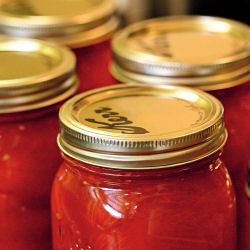 As summer fades into fall, I’m taking great comfort in our pantry full of canned tomatoes. Sometimes I just stand there with the doors open, gazing in at the luxury of summer’s bounty — more than 40 quarts in all — hedged against the privations of winter’s mealy produce. Bought from a local organic farmer at a seriously good price, these tomatoes were picked at their peak of ripeness and processed within 48 hours. Row upon row of jars sit in the cool larder, bright red orbs shining out of the darkness.
Gag-inducing, isn’t it? But I must confess that the road all this unseemly self-congratulation was paved with dismal failure.
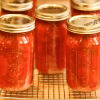
A few weekends ago, Cameron and I blanched and peeled 40 pounds of Mariquita Farms San Marzano tomatoes. Later in the day, Tea popped over to help us fill cases of quart-sized canning jars with our haul. Seven quarts at a time, we arranged our bounty into the shiny-new pressure canner, sealed the lid, and waited.
We’ve put up jams and preserves for many years, and pickles for at least the last five. But our first foray into the tomato realm was a rather limited success. Almost a third of the jars didn’t develop a proper seal. Of those that did, half lost so much liquid that we feared they would spoil. (Reputable books tell us not to worry: the contents may darken, but they’re safe to eat.) We toyed with the idea of re-processing the unsealed jars, but with no clue as to what had gone wrong and exhausted from a day on our feet, we decided that we’d had enough.
But the next morning, in what can only be described as a “when life gives you lemons” moment, I realized that we had everything on hand that we needed to make a giant batch of pasta sauce. I set the ingredients in a large kettle to simmer, and by bedtime we had dozens of quart-sized bags ready for the freezer. Surplus sauce will not be a problem. We eat our bastardized version of pasta Bolognese every Friday night, as it’s the kind of meal that makes its way to the table with a minimum of fuss. Cameron can whip up a simple salad and a side of garlic bread while the pasta boils, while I pore over my recipe files to plan the next week’s menu.
Determined to correct our mistakes (and unable to resist the siren song of ripe ‘maters), we bought another three crates. That’s 60 more pounds to make 100 pounds in all, for those of you keeping score at home. Guessing that our slightly lackadaisical jar-filling approach had been our undoing, we used a sterilized metal ruler to gauge the gap between the top of the tomatoes and the lip of each jar, ensuring that a half-inch of headspace — and not a millimeter more or less — remained.
Our measuring mania paid off: Not a failed seal in the batch, and a lot less liquid-loss, too. Now that we’ve got our technique dialed in, I can’t wait until next summer to try it again. In the meantime, even our failures yielded some nice side benefits: Our freezer’s overflowing with spaghetti sauce… probably just enough to last us through to next year’s Early Girls.
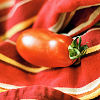


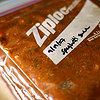
Not-Really-Bolognese Pasta Sauce
2 to 2-1/2 pounds ground meat*
3 cups chopped onion
4 to 6 cloves garlic, minced
12 oz white mushrooms, sliced
1T olive oil
3 quarts home-canned whole tomatoes, undrained (or 3 cans Muir Glen whole peeled tomatoes, with their juice, cut into chunks with kitchen shears)
2 cups tomato sauce
6 oz tomato paste (1 small can)
1 bottle (750 ml) red wine
1T kosher salt
2T dried Italian herbs (we use a combination of 2 parts thyme, 1 part rosemary and 1 part oregano from our garden; if using fresh herbs, triple the amount)
3/4 cup finely chopped flat-leaf parsley
Fry the meat in a large stockpot, breaking up into very small pieces. Add the onion and sweat until soft. Meanwhile, sautee the sliced mushrooms with the olive oil in a separate pan over medium heat until liquid evaporates; do not add salt. When onion is soft, add the garlic to the meat and cook 2 minutes. Drain off most of the fat from the meat and add the mushrooms, tomatoes, salt, herbs, tomato sauce, and tomato paste. Rinse out the tomato cans or jars with the wine, and add to the pot.
Cook for 2 to 3 hours (depending on the amount of liquid in your tomatoes), or until thickened to a dense sauce-like consistency. Add the chopped parsley and remove from the heat. Chill over an ice-water bath to room temperature, then chill overnight if desired. Package in 2-cup quantities in quart-sized freezer bags, and freeze flat.
Each bag will contain enough sauce to coat a half-pound of cooked dried pasta in the American style, to serve 2 to 3. After reheating, we like to add a bit of the pasta water and/or a touch of cream to the sauce before tossing with the pasta, to help the texture recover from the freeze-thaw cycle.
* Our ratio is usually something like 1-1/2 pound ground chuck, 1/2 pound ground pork, and 2 Italian sausages.
Italian, locavore, preserving & infusing, recipes
7 Comments »
