Posted by Anita on 02.16.09 11:52 PM
 The great irony of these troubled economic times is that cocktail budgets are shrinking just at the time when many of us really could use a strong drink. And even if you’ve survived the entire economic downturn syndrome — the downsizing, the furloughs, the real-estate bubble, and the credit crunch — unscathed, it feels a little too much like tempting fate to be drinking high on the hog while waiting for the other shoe to drop.
And thus we find ourselves on this particular Mixology Monday with the theme Hard Drinks for Hard Times, hosted by whiskey guru Matthew Rowley. Our assignment: “Write about an alcoholic drink you’ve made that resonates with the current economic turndown.”
But even widespread austerity measures don’t have to mean the end of the civilized ritual that a properly made cocktail affords. Off the top of my head, I can think of five painless ways to keep the cocktail hour rolling when we need it the most:
Secret #1: Switch your allegiance.
Perhaps the simplest way to economize on cocktail expenses — other than to drink less — is to drink cheaper booze. Duh. But I’m not advocating that you ignore your tastebuds and buy crap, or even settle for something you don’t enjoy. (We are still drinking for the pleasure of the well-crafted cocktail, correct?)
So, for example, if you’re fond of rye (and really, who isn’t?) consider a bottle of Old Overholt for everyday mixing; save that Sazerac or Rittenhouse for sipping, or at least for the drinks where the spirit is the star of the show. The shelves are filled with quality booze that’s nearly as good as the boutique brands, at a fraction of the cost. David Wondrich wrote up five of his favorites in a recent Esquire piece; I’m hoping we’ll hear a lot more about alternative brands from other MxMo posters.
Secret #2: Share the love.
If you need just an ounce or two of some obscure liqueur, don’t be afraid to ask your friends if they’ve got a bottle you can borrow. This works especially well if you have somebody like Erik living a few blocks away, like we do. But even if you have to make a special trip across town, you’ll have an excuse to buy your pal a drink.
The ground rules are the same ones your mama taught you back when your friends were loaning you Hot Wheels and Shaun Cassidy albums: Return the item in the same condition you found it, express gratitude in an appropriate fashion, and reiterate how happy you’ll be to return the favor down the road.
 Secret #3: Think small.
If you don’t have a ready network of cocktail geeks in your back yard, there’s still hope. Even the most math-challenged among us realizes that mini-bottles aren’t a great deal on an ounce-by-ounce basis. But if you only need a splash of something to test out a recipe – especially if it’s a type of liquor you aren’t sure you’ll love – tiny bottles can be a smarter bet.
A case in point: A few months back, I wanted to test a recipe that called for a small amount of Southern Comfort. But I’m not a great fan of flavored spirits, so this was a case where the $2.50 mini was a much wiser investment than the 750ml bottle at $15. (Special note to drink bloggers: Minis are often indistinguishable from their full-size counterparts in photographs, especially if you use a macro lens.)
Secret #4: Shop around.
If you’re lucky enough to live in a place that’s unencumbered by a state liquor monopoly, don’t be afraid to look for good-quality booze in unlikely places. Swanky spirits emporia may have all the beautiful bottles you need in one place, but they aren’t always a fantastic bargain. And — if you’re anything like me — it’s often impossible to get out the door without buying three (or five, or a dozen) things you couldn’t live without.
You can often find great deals at places that don’t necessarily specialize in spirits, like supermarkets (we keep our Safeway Club Card just for stocking up on staple booze), drugstores (a co-worker swears Rite-Aid has door-buster pricing on Sailor Jerry rum), and warehouse stores like Costco. Just make sure to walk straight past that twelve-pack of Swiffer refills, OK?
But when you’re clipping coupons and being an otherwise savvy consumer, don’t forget that the owner of your local quality liquor store — the one who makes great wine recommendations and offers to set aside bottles of special whiskey for you when it comes in — is also feeling the pinch. Certainly, buy your Beefeater in bulk, but when you’re getting excited about saving two bucks on a $25 bottle at the megamart, remember that if you don’t buy from the folks who really know their stuff, you’ll miss their expertise when the inevitable happens.
Secret #5: Drink seasonally.
If you’re a fan of drinks that have a substantial fruit or juice component, it pays to keep an eye on the calendar. Drink sours in the wintertime, Tequila por mi Amante in the spring, Bellinis in summertime, cobblers in the fall. Just as when you’re planning meals, follow the bumper crop for cocktail ingredients and you’ll find the best prices as the farmers market. And don’t be afraid to ask around; you may even get lucky enough to find a neighbor or co-worker with an abundance of backyard fruit to share.
If you know you won’t be able to live without your favorite fruity beverages in the off-season, consider simple preservation: Most fruits (and pretty much all juices) freeze well, and home-made cocktail cherries are among the simplest and most rewarding of spring pantry projects.
—-
In the spirit of the frugal tipple, we shook up a batch of Ward Eight cocktails — essentially a more-interesting twist on the venerable whiskey sour — using one of our favorite value-priced spirits, plus lemons from our own tree, and oranges given to us by a friend with an abundance of homegrown fruit. The grenadine is a homebrew version we keep on hand, made from store-bought pomegranate juice. The cherry garnish happens to be a gift from another thoughtful friend, but we could just as easily have used our own home-preserved version.
We’re sipping them out of gorgeous glassware, but — a-ha, an unbilled Secret #6! — we buy nearly all of our cocktail glasses secondhand. Thrift stores sell beautiful vintage glasses as cheaply as $0.50, and rarely higher than $2 a stem. An added bonus: Antique cocktail glasses are much smaller than their modern counterparts, so you can often split a single drink between two.





Ward Eight
2 oz rye whiskey (such as Old Overholt)
3/4 oz lemon juice
3/4 oz orange juice
1 teaspoon grenadine
Shake with ice and strain into a chilled cocktail glass.
drinks, Mixology Monday, recipes
14 Comments »


Posted by Anita on 02.09.09 10:52 PM
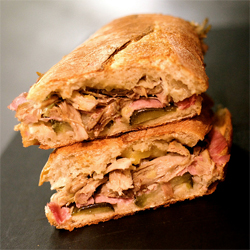 I keep teasing you about the pig roast, and — I’m sorry — this isn’t going to be that post, either. I’d like to say that it was such an epic event that I’m still wrapping my brain around it, or maybe that I am still trying to choose among the fabulous photos our friends took to illustrate the post.
In truth, my only excuse is that we had a rather… dramatic weekend, including one night that didn’t end until 4:30 the next morning — for entirely not-fun reasons. We’re all fine now, but all the drama meant there wasn’t a lot of time for rest, reflection, or anything resembling creativity, either in the kitchen or at the computer.
Luckily, there was a freezer full of pig-roast leftovers, which is like money in the bank as far as I’m concerned. Even with sleep-deprived brains, we knew well enough to thaw out a bag of pulled pork to feed our weary bones. On Sunday morning, Cameron pulled together another one of his famous hash-and-eggs brunches with part of the meat; later on, we dug up a couple of Acme grinder rolls and made Cubanos with the rest.
These Cuban-style pressed sandwiches — roast pork, ham, cheese, pickles, and mustard, all smooshed together into a crunchy-soft-chewy miracle — are just the sort of thing we want to eat when we need a little cheering up. If you happen to have some cabbage and carrots and onions around, I can vouch that Cubanos are pretty tasty with a quick slaw; all you need is mayo, cider vinegar, salt and pepper. Otherwise, a cup of black-bean soup would not be out of place, nor would a handful of banana chips.
 If you don’t have a freezer full of pulled pork (pobrecito!) you can substitute leftover roast chicken, or even leave out the roast meat completely. To compensate, add a little extra ham and cheese and you’ve got the makings of another venerable Cuban sandwich: the Medianoche — named, so they say, for the midnight hours when many are consumed, to fuel up for another round of late-night dancing or drinking.
You may read otherwise elsewhere, but you don’t need any special equipment to make a Cubano — though I am sure a panini press would be handy, if you happen to have one. Once you have all the ingredients on hand, a Cubano is simple to make, and it’s comfort food of the highest order. And really, couldn’t you use a little coddling?



Cuban Sandwiches
– adapted from Kitchen Sense
2 rustic sandwich rolls, about 6″ (or half a wide-ish baguette)
2-4T mustard
2T mayonnaise (optional)
1 whole kosher dill pickle
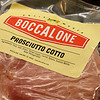
4 slices ham
4oz roast pork (or chicken), shredded
2 slices mild cheese (such as Jack or a mild Swiss)
Preheat a large cast-iron skillet or a griddle over medium heat.
Slice the pickle lengthwise into four pieces, and set aside. Cut the rolls lengthwise, leaving the back side attached as a hinge. Open the rolls up and spread a light layer of mustard on the inside bottom. If using mayonnaise (which I recommend unless your pork is very juicy), spread an even layer on the inside top half of each roll.
For each sandwich: Place two pickle slices on top of the mustard, then top with a slice of ham and half of the pulled pork. Top with a slice of cheese, and close up the sandwich.
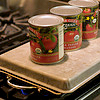
Place the sandwiches on the preheated skillet or griddle, and press down with a wide spatula. Top the sandwiches with a cookie sheet or a second skillet, and weight down (big tomato cans work well). Cook for 4 minutes, pressing down firmly on the weights every minute or so.
Using hotpads, remove the cookie sheet. Turn the sandwiches over and replace the sheet and weights, again pressing down firmly. The liquid from the pickles and ham will sizzle a little bit; this is a good sign. Cook for another 4 to 5 minutes, until the top of the roll is crispy and the cheese is melted. Remove from the pan and cut each sandwich in half; serve immediately while hot.
Dark Days challenge, locavore, meat, recipes
6 Comments »
Posted by Anita on 02.06.09 9:36 PM
 I know that it’s been awfully quiet around these parts for a while, but whirlwind trips to New York City will severely cut into your blogging time. The lovely folks at NOTCOT and Liqurious sent me on a hybrid photography/writing assignment to cover the launch of Rosangel, a new hibiscus-infused tequila from Gran Centenario.
You can probably guess that I don’t have a lot of personal affection for flavored spirits, but my better judgment prevailed: As freelance gigs go, getting to visit New York for a long weekend sure beats the hell out of just about anything else.
I fretted about how to make a rose-pink tequila sound credible to our cocktailian friends. But in all honesty, from what I was able to taste at the event, Rosangel has all the hallmarks of a quality product. It uses Gran Centenario reposado as its base, it’s aged for an additional 2 months in port casks to give it complexity and a rosy glow, and then it’s infused with hibiscus blossoms, not doctored with artificial flavors. I’m anxiously awaiting the chance to get my hands on a bottle to play with; the retail launch is set for March.
What I didn’t know when I accepted the assignment was that one of the events would be held at Clover Club, the newish Brooklyn bar from Julie Reiner of Flatiron Lounge fame. And, better still, that I’d have a chance to watch Ms. Reiner and Paul Pacult lead a hands-on immersion training for eight tequila-loving bartenders flown in from all around the country. (I won’t steal my own thunder any more than I already have: You’ll have to check out the NOTCOT post for the full scoop.)
So anyway, apologies for the radio silence. At least you know I had a good excuse! I promise there’s another post coming soon, all about the 70-pound pig we roasted for Cameron’s big birthday.





(Oh man, I shot so many frames… picking just five representative photos for the filmstrip this time is impossible! Please click through to see the whole collection.)
bar culture, drinks, NYC, other blogs
6 Comments »
Posted by Anita on 01.28.09 9:16 PM
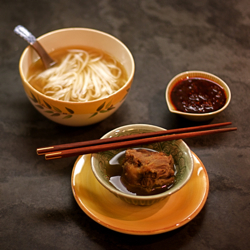 We usually consume our oxtails in an Italian-style ragu. But with Chinese New Year upon us — and the Year of the Ox, at that — it seemed like an Asian preparation would be more appropriate.
In the world of Chinese oxtail recipes, the options generally boil down to either a hearty braise with root vegetables, or a simple long-simmered soup. In the latter, the meat is simmered for hours until it’s meltingly tender, then served in two parts, much like a French pot-au-feu: a platter of meat with a piquant dipping sauce, and a bowl of clear broth to fill the belly and provide a respite from the spicy, meaty main.
Usually, rice would accompany the meat, but in the spirit of the New Year celebration, we opted to add noodles — which signify long life — to the broth. If you’re not so keen on eating out of two separate bowls, you can pull the meat off the oxtails and stir it in with the noodles and broth, then serve with the sauce on the side for each diner to stir in as she chooses.





Sichuan Oxtail Soup
– adapted from Land of Plenty and Classic Food of China
2-1/2 to 3 pounds of meaty oxtail
2 chicken drumsticks (or any two pieces of dark meat)
3- to 4-inch piece of fresh ginger, unpeeled
2 tsp whole Szechuan peppercorns
1/2 cup Shaoxing wine (or medium-dry sherry), divided use
6-8 oz dry rice noodles (your choice of width)
salt to taste
– Sauce
1T peanut oil
1/4 cup Sichuan-style chili bean paste
2 tsp dark soy sauce
2 tsp sesame oil
Soak the oxtail pieces in cold water for 30 minutes, then discard the soaking water.
In a large, heavy-bottomed pan, bring 3 quarts of water to a boil. Add the oxtail and chicken, and return to a boil. Skim off any foam that floats to the top, then reduce heat to maintain a steady simmer, stirring occasionally and adding water as needed to keep the oxtails mostly submerged.
Smash the ginger with the back of a knife or other heavy object. Add it to the pan along with the peppercorns and 1/4 cup of the Shaoxing wine. Partially cover the pan, and simmer for at least 3 hours.
Meanwhile, prepare the sauce: Heat the peanut oil in a wok or skillet until very hot but not smoking. Add the chili bean paste, and stir fry until the oil is deep red and the sauce is fragrant. Pour the sauce into a heatproof bowl; when cooled, add the soy sauce and sesame oil.
At the end of the simmering time, the oxtail should be very tender and the meat will pull away from the bone but not completely separate from it. Remove the oxtails to a plate, discarding the simmered-out chicken parts. Pick off any peppercorns that stick to the oxtails and discard. Drain the broth through a fine seive, discarding the peppercorns and ginger, and return the clear dark broth to the pot. You should have about 6-8 cups of soup at this point; add additional cold water if needed, or simmer down the broth. Once you have the proper quantity, add the remaining 1/4 cup Shaoxing wine, then salt the broth to taste. Return the oxtails to the pan and gently reheat until very hot. (If you want to serve the soup in one bowl, pick the meat from the bones before returning it to the broth.)
Meanwhile, prepare the rice noodles according to package directions. (Usually this involves soaking the noodles in boiling water, as opposed to simmering them.) When cooked, divide the noodles among 4 soup bowls, then ladle the hot broth over them. Serve the oxtails in a separate large bowl or tureen, moistened with a bit of the broth, and allow each diner to choose their piece, eating it out of a rice bowl by pulling the meat off the bone and dipping it in the sauce to taste.
holidays & occasions, meat, recipes
10 Comments »
Posted by Anita on 01.26.09 2:25 PM
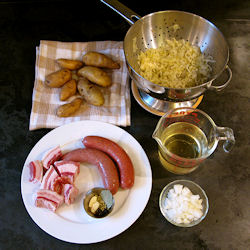 Along with our annual cassoulet, one of our favorite mid-winter traditions is simmering up a big pot of choucroute garnie — literally, garnished sauerkraut — in the Alsatian tradition. (Leave it to the French to come up with the brilliant idea of taking a delicious-but-homely pile of fermented cabbage and garnishing it with a pile of pork products.)
Every French traiteur worth his salted pork products keeps a giant crock of choucroute cru on hand, and it’s to this raw mixture that cooks will add their preferred mix of meats, wine, and seasonings. Here in the States, we have to look a little harder for the good stuff. At a minimum, start with refrigerated kraut — often found in bags or tubs near the chilled pickles at larger supermarkets. Even better would be to find a deli or artisan who sells fresh-fermented ‘kraut by the pint or the pound. However you source it, though, you want to start with crispy, bright shreds, not a mushy mash of greenish sog.
Once you’ve found the appropriate vegetable matter, you need to consider your garnishes. Nearly every choucroute recipe calls for white wine, potatoes, bay leaf, and juniper berries; meaty additions typically include multiple kinds of sausage, as well as either ham or pork belly. Variations include apples, slices of smoked pork loin, and even duck confit. Like most home-style dishes, the exact ingredients are a matter of regional and personal preference; it’s almost impossible to go wrong.
There’s really only one problem with traditional choucroute: Its size. Don’t get me wrong: It’s a lovely thing to make when you’re feeding a crowd, and like so many peasant foods, leftovers are possibly even better than the original meal. But for a midweek supper, the usual cocotte trés grande is a bit of overkill. But if you find yourself with a some sauerkraut hanging around — perhaps after making a flight of Reuben sandwiches? — you can make a smaller, simpler version with a small bag of easily-sourced market goodies.




Petite Choucroute
– loosely adapted from Anthony Bourdain’s Les Halles Cookbook
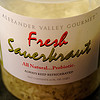
1 pound good-quality sauerkraut (we like Alexander Valley Gourmet)
4 fingerling potatoes
2T lard or bacon fat
1 small onion, diced
5 juniper berries
2 small garlic cloves
1 small bay leaf
1/2 tsp coriander seed
1/2 bottle (1.5 cups) dry-but-fruity white wine, such as Riesling
2 sausages, approximately 1/2 pound (* see note)
8oz pancetta (or slab bacon, pork belly, etc.), cut into 2-inch chunks
Rinse the sauerkraut in cold water and drain well. Boil the potatoes until slightly firm; cut in half and set aside.
Heat the pork fat in a medium saucepan over moderate heat. Saute the onion until softened. Add the sauerkraut, aromatics, and wine, plus salt and pepper to taste. Cover and bring to a simmer. Add the pancetta; recover and simmer over lowest heat for 90 minutes. Place the potatoes on top of the choucroute, cut side down, and tuck into the simmering liquid. Put the sausages on top of the choucroute; cover again and simmer gently until the potatoes and sausage are warmed through.
To serve, spoon the choucroute into two warmed, shallow bowls, dividing the meats and potatoes evenly. Serve with spicy mustard on the site.
—
* We typically use Fatted Calf knockwurst to complement Boccalone pancetta. Feel free to improvise with the sausages you’re able to find locally, or even to choose different meats. Bear in mind you want some contrast between the flavors, but that they should play well together. If you’re using slab bacon, try a sausage that isn’t smoked or heavily salted, like a mild bockwurst. Other winning combos include garlic sausages with duck confit (add the latter at the end instead of simmering it), or ham hocks with boudin blanc. If you’re using unsmoked sausages, you’ll need to poach them before adding to the choucroute for the final simmer.
Dark Days challenge, locavore, meat, recipes
5 Comments »
Posted by Anita on 01.19.09 10:38 PM
 When you go to London, if you’re at all interested in the mixological arts, I recommend you bring an ample supply of cash, a large bottle of milk thistle, and a suitcase full of bubble wrap. Dear reader, they have so many wonders across the Pond that we only dream of Stateside.
First among these treasures is a plethora of eye-poppingly gorgeous (not to say purse-poppingly pricey) cocktail establishments. The exchange rate is lately favourable to the American drinker, as much as can be possible. But a list of cocktails priced at £16, or £18, or even a heart-stopping £26 a sniff is bound to set even the hardiest of world travelers back on her heels. It was only the Christmas holidays and the attendant closure of many of the Capital’s top watering holes that saved us from coming home skint.
One of the key reasons for the allure of said establishments — apart from their five-star decor and their world-class staff — is the ability for a colonial to sample libations that simply never make it to our shores. Rare malts! Esoteric liqueurs! Cuban rums! The mind reels at the possibilities of the drinks that could be shaken, if only one had access to such wonders. (Happily, one does. Although London’s spirits emporia are small in number, they’re rich in merchandise, easily discovered, and more than happy to abuse your charge card in exchange for some very fragile cargo for the return flight.)
One of the best drinks we enjoyed while in London married both of these two alluring elements, the fantastically beautiful bar and the enticingly rare ingredient.
Aided and abetted by another London treasure, Jay Hepburn — proprietor of the spectacular blog known as Oh, Gosh! — we spent an evening taxing the hospitality of not one but two of London’s luxury-hotel lounges, the Bar at The Dorchester and Connaught Bar. Though our night at The Dorchester will forever remain a highlight of our London trip (due in no small part to the extraordinary welcome we received from our gregarious barman, Stefano, and his flawless drinks that kept us so enraptured that we missed the last train of the night!), the Connaught was a stunner.
It’s an opulent space, somehow embodying both splendid beauty and undeniably comfort. The staff are impeccable, gracious to a fault, and thoughtful to the utmost detail, from the first greeting to the last farewell. We were welcomed with a complimentary sip to enjoy while we perused the menu, then presented with a sheaf of recipes for the drinks we’d enjoyed at the end of the evening — an enchanting gesture that I hope will be the start of an international trend.
Though we savored many wonderful drinks that night, the final nod must go to the very first I tasted at Connaught Bar: a complex, spicy bit of exotica known as the French Sin. It’s not a simple drink to make, requiring a flavoured sugar, a barely seasonal fruit, a rare vermouth, and a carbonated tea infusion. Nevertheless, the rewards, as they say, are in the glass.
The French Sin also makes a perfect candidate for this month’s Mixology Monday: New Horizons, hosted by the anonymous Scribe of A Mixed Dram. Encouraged to sample a new spirit (amber vermouth, check!) or a new technique (carbonating tea — check again!), the French Sin covers all the bases. But if for some reason, you can’t be bothered to fizz your own tea, procure a bottle of rare vermouth, or infuse vanilla beans into sugar, never fear: The gentlemen of the Connaught Bar will be happy to oblige.




French Sin
– Connaught Bar, London
1/2 fresh fig
1/2T to 1T vanilla sugar
1-1/2 oz Armagnac
1/2 oz amber vermouth
3/4 oz lemon juice
3/4 oz rooibos spiced soda water
Muddle the fig in the shaker with the vanilla sugar, then add the rest of the ingredients — other than the spiced soda water — and shake with ice. Double-strain into a small goblet and top with rooibos spiced soda water, and stir briefly to combine. Garnish with a quarter of a fig.
—
If figs are out of season, look for the freshest dried figs available. Rehydrate them in a small amount of hot (not boiling) water until soft enough to muddle. For garnish, use a lemon twist or a yellow flower, reminiscent of a vanilla orchid.
Vanilla sugar can be purchased in gourmet shops or spice stores — Penzey’s makes a nice one, as does Nielsen-Massey. To make your own, grind a half of a dry vanilla bean in a spice grinder or coffee grinder with a small amount of granulated sugar. Add this vanilla powder to 1 cup sugar and let sit at least 24 hours (and preferably up to a week) before using. In this recipe, you can use the sugar as-is, since you’ll be straining the shaken mixture, but in baked goods or as a general sweetener, use a fine sieve to remove the larger pieces of vanilla pod after the infusing is complete.
To make the rooibos spiced soda, steep 4 tsp spiced rooibos tea (or 1T pure rooibos tea plus a few cardamom pods, whole peppercorns, and cloves) in a quart of hot water for 5 minutes. Strain, chill thoroughly, and charge in a soda siphon.
bar culture, coffee & tea, London, Mixology Monday, recipes
8 Comments »
Posted by Anita on 01.19.09 7:54 AM
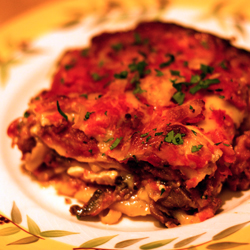 It must happen to everyone: That moment when you lose all ambition for trying new recipes and just fall back on the tried and true, the comfort foods that make your heart and belly happy, with a minimum of fuss.
Last week, Cameron came down with a doozy of a cold. It wasn’t really terrible, in the symptoms department, but it seemed to go on forever and ever. It wasn’t the end of the world, but it was just annoying enough to keep him home, working at the dining room table and sipping mug after mug of lemon and honey. In much the same way, taking care of the house and the dogs all on my own isn’t really traumatic, but it is time-comsuming… and the thought of coming home and spending an hour or more in the kitchen — especially all alone — wasn’t terribly appealing. I looked for recipes that I could prep, preferrably in the morning or the night before, and then pop into the oven when I got home. And, of course, they had to appeal to the palate of a guy who had a head full of winter weather.
Unfortunately for you, and for my narrative, the two all-local meals we ate last week were both repeats: My mom’s famous meatloaf — with Dirty Girl romanesco and baked Little’s potatoes on the side — and a thrown-together lasagna using home-canned tomatoes, locally made cheeses and fresh pasta.
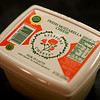
For both of these meals, I took a slightly different route than my usual, mixing ground pork from our meat CSA with spices to make bulk sausage — home-grown sage for the meatloaf’s breakfast sausage, and home-grown fennel seed for the lasagna’s Italian sausage. Of course, the texture’s no match against real home-ground sausage, but in a highly flavored dish like lasagne, the difference is fairly negligible. And the taste? Comforting and hearty, just like always.




Quick Italian Sausage
1 pound ground pork (at least 30% fat)
1T kosher salt
1T fennel seed
1-1/2 tsp coarse black pepper
3/4 tsp sugar
2-3T ice cold water
Mix all ingredients together well. Fry a small test patty to taste for salt and seasoning, and adjust as needed. Let sit overnight, if possible, to allow flavors to blend.
Dark Days challenge, Italian, locavore, meat, recipes
5 Comments »
Posted by Anita on 01.12.09 7:22 PM
 After two-plus weeks in London, we knew it was going to be difficult to get back to the grind, and the cold, grey weather here in San Francisco wasn’t doing anything to help us get over our jetlag.
In a rare fit of travel wisdom, I’d planned our return for Saturday, to give us time to do little things like food shopping and laundry before heading back to work. But we arrived home far too late to get to our usual market at the Ferry Plaza, and the idea of trudging through a brightly lit supermarket didn’t seem the slightest bit appealing.
So after a fortifying Sunday morning breakfast, we headed across the Golden Gate bridge, in search of the Marin Civic Center farmers market. Even though this market isn’t much further from home than the downtown Berkeley market, we’d never checked it out. What we found was pretty impressive: A good number of stalls — maybe close to 100 — with a lot of variety, even in the middle of winter.
We certainly had no problem finding meat. Marin Sun Farms was there, as were the Prather Ranch boys and Devil’s Gulch Ranch — a name we’ve seen on menus, but never bought; they don’t sell at the SF markets. By the time we arrived, all they had left was a big five-pound pork shoulder roast. We hemmed and hawed, then decided that we could make a big batch of carnitas and save the leftovers for a later meal. A vendor from San Luis Obispo — technically outside our challenge radius, but we fudged it — was selling avocados, and a bakery from Sacramento had corn tortillas; we’d made the right decision.
We also picked up a pretty bone-in pork chop from Marin Sun, plus the usual assortment of vegetables and starches. Once we returned home, I popped the pork chop in my usual cider brine for a few hours. For our first Challenge meal of the week, we served it with mashed potatoes and a really nice chopped salad of romaine, avocado, radishes, carrots, and cucumbers, all tossed in a citrusy dressing and topped with grated dry Jack. (I was mimicking a salad I used to love ordering at Two before they went downhill, and I think I got pretty darned close.)
Every time I opened the fridge, that enormous pork shoulder was staring back at me. With a full week of evening commitments ahead, I quickly figured out that I’d bitten off more than I could chew; there just wasn’t time in our schedule for the full evening of patient simmering that carnitas requires. And with a slate of office projects piling up, there was no way I could work from home to coddle it.
I wondered aloud if the Crock-Pot might offer a solution, and Cameron agreed that it might be worth a try. “The worst thing that happens is you end up with pork stew.” A quick cruise around the Web didn’t really turn up much in the way of a trustworthy recipe, so I decided to wing it. I used our usual carnitas recipe, with a couple of changes: I left the meat in larger chunks to combat the tendency for everything to turn to mush. I also reduced the liquid — slow cookers retain a lot more moisture than even the best-sealed pots — and kicked up the brightness with a little citrus, to compensate for slow cooking’s flavor-dulling effect.
I’d popped the ingredients in the pot, then headed to the office, fully expecting to return home in about 8 hours to keep an eye on the tail end of the cooking process. Naturally, work dramas conspired against me, so it was nearly 12 hours later that I walked in the front door. A heavenly smell from the kitchen relieved some of my fears that I’d created a pile of overcooked, dry slop.
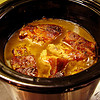
I shouldn’t have fretted. The part of the meat that wasn’t submerged got pretty toasty… an unexpected bonus. The rest of the meat was perfectly cooked, juicy and tender, with just enough connective tissue left to keep things together until you hit it with a fork.
In a traditional carnitas recipe, the braising liquid gets simmered down — with the meat in it — at the end of the cooking process; the meat gets nice and crispy in the fat that remains after the broth simmers away. To simulate this effect, we drained the juices and skimmed off the fat to sear the meat. And as a bonus, we have an ice-cube tray full of really yummy pork broth.




Crock-Pot Carnitas
4 pound boneless pork shoulder
1T whole cumin seed, lightly chopped or crushed
2 bay leaves
1 onion, quartered
1 cup rich pork or chicken stock
1 oz orange juice or Meyer lemon juice
salt, to taste
water, as needed
Cut the pork shoulder into large chunks, and sprinkle with the salt and cumin. Place in the Crock-Pot with the bay, onions, stock, and juice. Add enough water, if needed, to come halfway up the meat. Cover with lid, set pot on low, and cook for 10-12 hours, until meat is very tender.
Remove the meat from the pot and set aside in a warm place. Pour the cooking liquid into a fat separator, let settle, and then pour the defatted broth into a wide pan or baking dish to cool, reserving for another use. (Alternately, use a glass measuring cup and a turkey baster to separate the fat from the broth, or your usual fat-separating method.)
Heat a large skillet, and add enough of the skimmed carnitas fat to the pan to cover the surface well. Pull the meat apart, creating pieces approximately 1 inch long, and add to the pan once the fat is sizzling. Brown the meat until crispy on the outside, turning with tongs as needed. Remove each piece from the pan as it browns on all sides, keeping warm until ready to serve.
Serve with warm tortillas and your choice of condiments: salsa, chopped cilantro and onions, guacamole, sliced radishes, etc.
Dark Days challenge, farmers markets, locavore, meat, recipes
6 Comments »
Posted by Anita on 01.03.09 7:53 PM
 When you live on an island that’s a mere 300 miles wide, local food is a relative thing. In the map to the left, the blue pin shows the location of our London flat. The green circle — which touches the Normandy coast of France — shows a 100-mile radius; yellow encompasses 150 miles, and blue — which grazes Paris! — illustrates the 200-mile radius that many wintertime eat-local challenges allow.
Looks like it would be easy to eat local, doesn’t it? I’m sure with a little practice and a bit of hunting, it definitely could be. But when you’re on holiday and have no understanding of where cities, counties, and postcodes are situated within Britain, it’s definitely a challenge. And when we discovered that most of London’s farmers markets run on a reduced schedule and roster for the run-up to Christmas, we thought we might have to call a vacation hiatus on making our weekly Dark Days meal from all-local ingredients.
Our biggest shock came on an afternoon trip to the world-famous Borough Market, the place we assumed would be the highlight of our shopping excursions. But although it’s still a feast for the eyes, it’s definitely taken on a more-corporate feeling since our last visit. And despite the wealth of delectables on offer, we found it nearly impossible to unearth items grown or produced local to London. One very pleasant exception: Mrs King’s gorgeous raised-crust pork pies are made in the appellation-controlled region of Melton Mowbray, about 90 miles from London.
Most of the bread we found, at Borough and in shops, was baked either on the outskirts of London, or in nearby Oxfordshire. Once we got a little basic geography under our belts, finding local ales and ciders was easy-peasy, even in the big supermarkets. And many well-regarded packaged products — preserves, pickles, mustards, crackers, cookies, and so forth — are made in Britain, if not within southern England per se.
If you’re willing to leave the foodie haunts and supermarkets behind, the news gets better. FARMA-certified London Farmers’ Markets have some of the most thorough guidelines I’ve ever seen, touching on everything from permissible ingredients in artisan goods to animal welfare to to maximum distances traveled: Everything sold must be “raised, grown, produced, gathered, caught, or baked within 100 miles of the M25”, London’s exterior beltway. Even on a very slow week at the Marylebone Farmers Market, we were able to cobble together a full meal: Sausages (produced on Food Fore Thought‘s East Sussex farm, using their own-raised pork), Brussels sprouts, and potatoes, which we served with a store-bought bottle of real ale from Hook Norton in Oxfordshire, 81 miles from London.
And in the world beyond all-local, the news is better still. Even in mainstream supermarkets like Waitrose and Sainsbury’s, it’s easy to find cage-free eggs and pastured chickens; a solid majority of carton eggs sold in the UK are cage-free. Thanks to many campaigns by celebrity chefs like Jamie Oliver and Hugh Fearnley-Whittingstall, Britons are by now far more aware of the intrinsic cruelty of the battery hen system than the average consumer here at home. And in England, organic certification — the kind you see stamped on supermarket chickens — means more. It’s not just a simple matter of feeding Chinese organic soy to your animals; the Soil Association (Britain’s main certification agency) guidelines call not just for a cage-free environment, but true “freedom to range”.
Lest you think this means a giant warehouse with a tiny door to a barren yard, the guidelines actually stipulate that birds may not even be permanently housed, and that their forage must be “well-covered with suitable vegetation”. And SA-certified poultry isn’t just something you’ll find in posh shops: Even on the New Year’s Day bank holiday, we had no trouble finding SA-certified organic chicken parts in a ‘Sainsbury Local’, a neighborhood grocery the size of a 7-11. We couldn’t find any evidence that this meat was local to us, but it was labeled “product of Britain”, as were many meat packages we saw and bought.
Despite handicaps of seasonality and familiarity, I feel like we were able to do quite well, rather easily. It’s hard to ignore the feeling that it feels easier to put together an ethical and reasonably environmentally sensitive meal in London than in nearly any other large city we’ve visited.





Dark Days challenge, farmers markets, locavore, London
4 Comments »
Posted by Anita on 12.28.08 6:34 AM
 Even in the foodie heaven that is San Francisco, there’s no place like Konstam at the Prince Albert. A Victorian pub that’s been converted to a high-design jewelbox restaurant — it would take an entire paragraph just to explain the chandeliers-slash-draperies — Konstam toes the eat-local line with none of the obfuscation inherent in the standard “….whenever possible” disclaimer of Bay Area menus.
Even more impressively, Konstam’s sourcing radius is dramatically smaller than the usual 100-mile American definition: 85% of the kitchen’s ingredients, including flour and protein, come from the area covered by the London Underground and/or bounded by the M25 beltway, depending on where you’re reading. Either way, we’re talking about more or less 25 miles from central London.
One more thing: It seems that the idea to source ingredients locally was written into the restaurant’s plan before Chef Oliver Rowe really knew it was possible — but after a television deal had been signed. As a result, his tiny temple to seasonal and local food was well-known to British foodies even before the first meal was served. A two-week BBC miniseries called The Urban Chef documented the trials and tribulations of opening Konstam and finding suppliers. Watching video of Chef Rowe scouring the outer reaches of London feels like nothing so much as a giant, £300,000 dare… with the entire country watching each night on the telly.
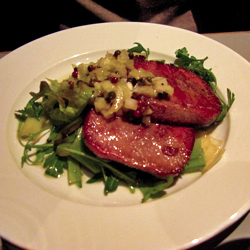
But enough about the schtick: How’s the food? Rowe wisely chose Northern and Central Europe as his inspiration, so even in the dead of an English winter, there’s sense to be made of the menu. A bowl of celeriac and apple soup came scattered with abundant hazelnuts, chunks of blue cheese, and a sprinkling of dill; the portion was far too large for such a dense porridge, but the flavors were lovely. Cameron enjoyed a starter of grilled Sevenoaks ox tongue, perfectly buttery-soft but meaty, garnished with a piquant pickled peppercorn relish atop a slick leek salad. It’s hard to choose which of our mains was the winner: Cameron chose perfectly charcoal-grilled leg of mutton, served with intensely vegetal chard and comforting colcannon. My own moan-inducing roast pork belly — complete with scored crispy crackling — came with both picture-perfect roast potatoes and a too-sweet cabbage compote.
Although the wine list includes mostly Continental offerings, you can opt for a well-balanced choice of English wines from Kent, about 60 miles away, or pick from a great assortment of local ciders and ales from artisanal producers. We sampled the Sauvignon Blanc-like Chapel Down white and the funky Burrow Hill extra-dry cider; neither required the expected “pretty nice… for a local product” caveats.
Dessert was a modern take on traditional Victoria sponge — cake layered with cream and preserves — drizzled with vanilla syrup. Simple and exceedingly sweet, it would have been lovely with the espresso we ordered, but never received. And on that note: London will never be known for its stellar table service, but Konstam’s was even a step below the usual indifference. We were so happy with our food that we weren’t too troubled, but I can conjur a mood where we would have been furious at all the many issues with poor pacing, forgotten items, and long stretches of time where waitstaff simply disappeared — no mean feat in a restaurant the size of a large living room.
You could imagine Konstam being a worthwhile destination simply as a curiosity, a stunt-piece of a restaurant built on a conceit that might age poorly. But even without its locavore angle, the food delivers without offering (or requiring) any apologies for its constraints.





Konstam at the Prince Albert
2 Acton Street
London, WC1X 9NA
020 7833 5040
Dark Days challenge, locavore, London, restaurants
1 Comment »
