Posted by Anita on 05.22.08 1:07 PM
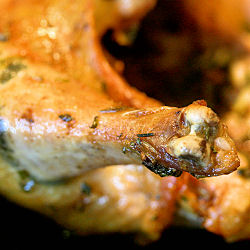 “A whole bird, slaughtered for the nourishment and pleasure of the entire family, is a conspicuous display — if not of serious wealth, then at least of comfort and contentment.
These days, it is also one of the few family meals that demands to be eaten at the table, rather than in front of the television. And, more important perhaps, it is one of the few dishes that is actually capable of getting disparate family members around that table without protest.”
— Hugh Fearnley-Whittingstall,
The River Cottage Meat Book
.
KJ over at A Cracking Good Egg tagged me for the Book Wisdom meme:
1. Pick up the nearest [foodie] book.
2. Open to page 123.
3. Find the fifth sentence.
4. Post the next three sentences.
5. Tag 5 other people* and acknowledge who tagged you.
(* I don’t mind being tagged, but I know other bloggers who feel it’s an imposition. So, let me know in the comments if you want to play along.)
I’m not sure why it’s taken me this long to share The River Cottage Meat Book with you. Even though I’ve had it close at hand since Christmas — it’s always either on the coffee table or my nightstand — I am still wrapping my head around this volume. It’s not that I don’t know that I love it (because I most definitely do). And it’s not that I haven’t cooked out of it enough (because I definitely have). Nor is it because I don’t know if it’s worth your $40 investment (because it definitely is). And it’s not even that I am worried you’ll be unsettled by the beautifully photographed images and descriptions of ethically raised farm animals as they make their way from field to food (because I definitely was).
But despite my unequivocal endorsement — when I win the lottery, I’ll buy a copy for every omnivore I know — I also feel like it might take me years to fully explore this 500+ page treatise of meaty pleasures. It’s not the sort of lighthearted summer cookbook that inspires you to casually toss off a post and then go back to planning next week’s menu. It’s a thinking-man’s cookbook that’s unabashedly carnal and carnivorous, with plenty of thought-provoking commentary woven into its mouthwatering menus.
Don’t get me wrong: It’s no mere meat manifesto. Fearnley-Whittingstall somehow walks an ethical omnivore’s path that’s neither preachy nor overly sentimental. He’s straightforward in that very English sort of way, unromantic and yet so obviously enthralled in what he is doing that you can’t help but wish for your own bucolic farm on the rolling hills of West Dorset (picturesque stone house included). And although the Pollan-esque prose on carnivore ethics is what sets The River Cottage Meat Book apart most directly from most any other cookbook, it’s far from the only reason for owning it.
The book is chock full of useful information about how to purchase meat, even when a supermarket is your only resource. There’s an entire summary chapter devoted to meat thrift — an idea that Fearnley-Whittingstall takes pains to explain has nothing to do with being miserly, despite the obvious frugality. In between, the author shares his vast knowledge on the cuts of meat available from each of the major species, as well as offering up weighty chapters on each sort of cooking: roasting, slow cooking, fast cooking, barbecuing (by which he means grilling), and preserving. From the humblest cottage pie to the most elaborate holiday feast, the recipes are so engaging that you’ll find yourself plotting your next meal around them before you’ve reached the bottom of the page.
Now, you wouldn’t think that a simple roast chicken would tolerate much variation from the usual preparation: Season it, roast it, rest it, carve it. But it’s the little things that set the River Cottage method apart. First, the amount of butter used is quite frankly astounding, but once you taste the end result you’ll be happy you followed directions. The unorthodox technique — opening the body cavity wide; making multiple temperature adjustments; dousing the roasted meat in the buttery drippings — yields a moist bird with shatteringly crunchy skin, despite a relatively brief cooking time. It’s practically the antithesis of the widely lauded Zuni Cafe method, but the end result is equally eye-opening.
—
When I write about a dish I’ve made from a published source, I usually rewrite the recipe in my own words. (Listing a single recipe verbatim is almost certainly within the bounds of fair use, but as a professional writer I’m hypersensitive to issues of authorship. Call me wacky.) But this time, I’m giving you the real McCoy. Not so much because I want you to make this roast chicken — although I suspect it would make a nice change from your usual method, as it was for us — but because I want you to understand the author’s gift of turning even this simple weekend classic into an exercise in clarity, poetry, and deliciousness.
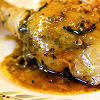

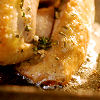
Herb Roast Chicken
– excerpted from The River Cottage Meat Book
1 small but plump roasting chicken weighing about 3 to 4 pounds
7 tablespoons soft butter
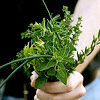
generous handfuls of fresh herbs, roughly chopped
1 garlic clove, crushed
1/2 glass of white wine
salt and freshly ground black pepper
Take off any string or elastic trussing from the chicken, place the bird in a roasting pan, and spread out its legs from the body. Enlarge the opening of the cavity with your fingers, so hot air can circulate inside the bird. It will cook quicker like that.
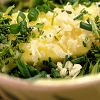
Put the butter in a bowl, throw in the roughly chopped herbs and the garlic, and season well with salt and pepper. Mix together with your fingers, then smear all over the chicken, inside and out. (Note from Anita: I also gently loosen the skin and spread some butter directly onto the meat. Yum.)
Place in the center of a hot oven (400F) and leave for 20 minutes (phase 1). Then baste the chicken [with the drippings], turn the oven down to 350F, pour the wine into the pan (not over the bird), and roast the bird for another 30 to 40 minutes (phase 2), depending on its size. Open the oven door, turn the oven off, and leave the bird for 15 to 20 minutes (phase 3). This is usually enough time to roast a small chicken through without burning the skin (the reason I prefer small chickens for roasting.) For a bigger bird, you will have to make the necessary adjustments, adding a few minutes to each phase. You may also wish to protect the bird’s skin with buttered foil for, say, the first 20 minutes of phase 2. A good test for doneness is to pierce that part of the bird where the thigh joins the breast; the juices released should run clear.
Forget about gravy. Carve the bird in the pan, as coarsely and crudely as you like (no wafer-thin breast slices, please), letting the pieces fall into the buttery pan juices and letting the fresh juices from carving mingle with the rest. Then take the pan to the table and pass it round your family or guests in the pecking order of your choosing, so they can pull out the bits they fancy. Pass it round a second time, to help redress grievances and encourage the further and fairer distribution of juices.
Accompaniments? Roast potatoes would be de trop. A green vegetable would probably go unnoticed. Some good bread to mop up the juices will be appreciated, while a leafy salad, produced only after your guests have demolished the chicken, might assuage a few guilty consciences.
The discover of the roasting pan, a day or so later in a cool larder, is a joy you may not wish to share. Plundered the jellied juices, congealed bits of skin, and crusty meat tatters that cling to the carcass before you quietly make the rest, along with the giblets, into stock.
cookbooks, cooking, meat, other blogs
22 Comments »


Posted by Anita on 05.12.08 12:09 AM
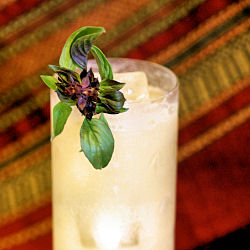 I’m a big fan of Food & Wine magazine’s annual pocket-sized cocktail compilations. I picked up my first edition a few years back as an impulse buy in the supermarket checkout lane. Flipping through the slim volume while the woman in front of me attempted to write a check for her $4 order, I spied a recipe from the Zig-Zag boys and bought it on the spot.
Every year since then, I’ve waited impatiently for the new version each spring. Though I don’t always find a new favorite, there are enough “keeper” recipes in every edition that it’s worth the small expense — about $10 — and the photography and prop styling offer plenty of visual inspiration.
This year’s edition features a whopping 17 recipes from Bay Area bars and restaurants, including favorites like Nopa, Forbidden Island, Alembic, and more. Surely, I thought, there must be a good rum recipe in there, worthy of this month’s Mixology Monday roundup — hosted, aptly enough, by Trader Tiki.
Alas, somebody at F&W missed the memo about rum’s hot streak: A good chunk of the drinks in the Rum chapter are actually made with rum’s Brazilan cousin, cachaça. But one concoction did catch my eye: Scott Beattie’s “Thai Boxer” — a vanilla-rum drink that uses unsweetened coconut milk, muddled Asian herbs, and a dose of ginger ale. Truthfully, I’m not a huge fan of culinary cocktails that require a grocery-store excursion, but it just so happens that (a) I keep a case of coconut milk on hand for Thai curries and (b) we actually have all the herb ingredients growing in our yard.
Much as I love the folks at Charbay, I was reluctant to splash out $35+ for a bottle of their boutique vanilla rum, not knowing if I’d find another use for it. Perhaps it was a blessing in disguise: There wasn’t a single bottle to be found at any of my regular liquor shops. Happily, spiced spirits are one of the quickest and easiest infusions to make, and I was very pleased with my first effort at home-made vanilla rum.
But back to the recipe: Once the shopping’s done and the vanilla rum’s steeped, the hard part’s definitely done. I took the liberty of replacing the original recipe’s simple syrup with an equal amount of Canton ginger liqueur to double up the ginger beer’s flavor. Much like its namesake, this Thai Boxer’s a cute little thing with a surprisingly lethal kick.




Thai Boxer
– Adapted from a recipe by Scott Beattie in Food & Wine Cocktails 2008
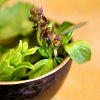
10 leaves Thai basil, plus a sprig for garnish
 10 leaves fresh mint
10 leaves cilantro
1/2 oz Canton ginger liqueur, or simple syrup
1-1/2 oz vanilla rum (see Note 1)
1 oz lime juice
1/2 oz unsweetened coconut milk (see Note 2)
ginger beer, or a quality ginger ale
In a mixing glass, muddle the herbs with the liqueur or syrup. Add the rum, lime juice, coconut milk, and shake with ice until well chilled. Double-strain (using a Hawthorne strainer to hold back the ice and a fine sieve to catch the bits of herbs) into an ice-filled highball glass, and top with ginger beer. Garnish with a spring of Thai basil.
Note 1: If you can’t find a natural vanilla rum — Beattie recommends Charbay Tahitian Vanilla, which seems to be in short supply, even here in the Bay Area — it’s easy to make your own. Split and finely grind (or chop) a vanilla bean and steep in 8oz of white rum. Shake periodically, and strain through cheesecloth after 48 hours. Whatever you do, please steer clear of the artificially enhanced mass-market brands.
Note 2: You’re looking for the unsweetened Asian stuff here, not that ‘coco creme‘ crap. Try to not shake the coconut milk before using. In fact, it’s best if you can refrigerate the can for a day beforehand to allow the coconut cream to rise to the top and solidify. Be sure you’re using the thinner, watery milk at the bottom of the can for this recipe, or you’ll end up with an unappetizing film on the sides of the glass and a greasy-tasting drink.
—–
Other Drink of the Week posts featuring Rum:
Millionaire Cocktail #1 with Plymouth Sloe Gin
Fugu for Two at Forbidden Island
Dark & Stormy, San Francisco’s winter fave
Mai Tai at the Tiki-ti
Piña Coladas, au naturel
Mojitos a la Murray
Corn ‘n’ Oil, Cameron’s favorite rum drink
Bloody Beach, a Blood and Sand variation
Eggnog for a festive occasion
Painkillers straight from Tortola
Jolly Roger, for Talk Like a Pirate Day
Canton (aka Chinese Cocktail), the very first DOTW
cookbooks, Drink of the Week, drinks, Mixology Monday, recipes
9 Comments »
Posted by Anita on 05.10.08 5:48 PM
 Our usual Saturday breakfast excursions to Primavera — the legendary Mexican-food stall at the Ferry Plaza Farmers Market — are not without a downside. Eating a big plate of chilaquiles or fish tacos or tostadas de ceviche at 9am means we’re rarely hungry for lunch before mid-afternoon.
Sometimes we’re smart enough to start supper preparations early enough to head off the inevitable 4 o’clock stomach-rumblings. But more often than not, we’re grabbing leftovers or heading to one of our local cheap-eats standbys for a quick bite. Of course, this course of action only prolongs our agony: In our hunger, we eat a full meal.. and then we’re rarely in the mood for for a full-sized dinner. But if we skip our usual evening meal, we often find ourselves hungry again by bedtime.
Clearly, the smart thing to would be to plan for this eventuality, stocking the larder with a few larger-than-snack, smaller-than-meal options for weekend needs. Obviously, we’re not too bright; we know we need to do this, but it’s one of those things that just ain’t glamorous enough to make it to the top of the to-do list.
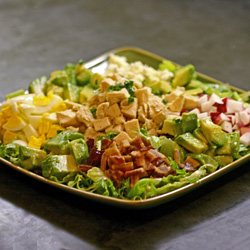
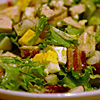
Last weekend, while rooting through the fridge, I realized that we had all the makings of a really fabulous Cobb salad. (I’m not entirely sure why it took me so long to notice this; it’s not like eggs, bacon, or avocados are any stranger to our kitchen.) Even if we had been lacking one of the main ingredients — tomatoes aren’t always in season, and avocados do go away for a few months, even here in California — this meat-blessed salad makes an adaptable standby, ready to alleviate hunger pangs without stuffing you to the gills.
The best part of making a Cobb at home isn’t that you get to use fabulous ingredients, although that’s undeniably a strong argument in favor of the do-it-yourself approach. No, the very best reason is that you get to toss the damned thing in a proper bowl before plating it. Don’t get me wrong: A prettily composed Cobb is a thing of beauty. But whenever I order one at a restaurant, I end up regretting it. The first few bites are fine, but by the time I’m halfway done, my tastebuds are exhausted by the onslaught of salty, potent flavors. If I push on bravely, I’m left with underdressed, undergarnished lettuce at the bottom of a very sad bowl.
My mom’s a fan of the Cobb salad — and, yes, she’s as neurotic about un-tossed salads as I am. (Maybe that’s where I got it? Hmm…) So whipping up a Cobb salad seems like an especially appropriate Mother’s Day treat.



Cobb Salad
— serves 4 as a main course
10-12 cups torn lettuce
– preferably a combination of romaine, red leaf, and something spiky like frisee or escarole
8 strips of bacon, cooked medium-crisp
1 to 2 cups cooked chicken
4 hard-boiled eggs
2 medium avocados
1 cup grape tomatoes, halved (or 1 cup diced radishes when tomatoes aren’t in season)
1 cup crumbled blue cheese
2T chopped fresh chives
—
2T red-wine vinegar
2 cloves garlic, pressed*
1 tsp salt
1/2 tsp black pepper
1/2 tsp Worcestershire sauce
1/2 tsp lemon juice
1/2 cup olive oil
Cut the bacon, chicken, eggs, and avocado into 1/2-inch pieces; set aside.
Whisk together the vinegar, garlic, salt, pepper, Worcestershire, and lemon juice. Slowly drizzle in the oil, whisking until emulsified.
Toss the lettuce with 2/3 of the dressing, and arrange the tossed lettuce on a deep platter or shallow pasta-serving bowl. Toss the chicken cubes with the remaining dressing, and place the chicken in the center of the lettuce, in a tidy pile. Surround the chicken with the remaining ingredients, each one stacked in its own pile. Sprinkle the composed salad with chives.
Show off your beautiful salad to your dining companions, then return to the kitchen to toss all ingredients together. Serve in 4 chilled pasta bowls or other entree-sized shallow bowls.
* I’m not normally in favor of the garlic press, but I think that making salad dressings is one application where it really shines.
cooking, locavore, recipes
7 Comments »
Posted by Anita on 05.05.08 10:19 PM
 The San Francisco cocktail circuit is a pretty cozy scene. It’s not just that bartenders pick up shifts at three or four different bars or restaurants in as many nights, although that helps. It’s more that for some reason, every now and then, a somewhat obscure cocktail will simultaneously capture the imaginations of multiple menu-writers. Suddenly you see the darned thing everywhere.
Last fall, the cocktail of the moment was the Dark n’ Stormy; every watering hole in The City had it on their menu, and pretty soon Gosling’s Black Seal was a common sight on the speedrail. The effect is so pervasive it feels like one of those community reading programs where everyone skims the same hardback on the subway, except here in SF, it’s “One City, One Drink“.
Winter’s finally over, and so the ginger beer, sadly, is making its way back to the cellar. But ready to take its place, you’ll find a slew of imported, artisanal, and home-brewed grapefruit sodas. Paired with a healthy glug of reposado tequila, a pinch of salt, and the juice of half a lime, you’ve got yourself a Mexican fiesta in a glass, that lazy-man’s margarita known as the Paloma.
Of course, it wouldn’t be San Francisco without some liberties taken. Over at the Chronicle, our pal Jane details three different SF bars offering their own twists on the Paloma. Alembic uses homemade soda and some spicy secret ingredient; newcomer Beretta adds elderflower and Cointreau… hmm. I’m sure they’re lovely, but honestly (and here’s something you won’t hear me saying often) I’m pretty sure I’d rather try my luck at Tres Agaves. Their straight-ahead, old-school version uses Jarritos soda, which — after sampling Squirt, Hansens, and Fresca — I’m going to say is an essential ingredient. So please, hit up your local bodega or taqueria, and look for the bottle marked “toronja”.
My one deviation from the Paloma recipe you’ll find at beachfront cantinas up and down the Baja coast is a good shake of Fee Brothers’ Grapefruit Bitters. They’re optional, of course… but they add a delightful boost of grapefruit-peel flavor and accentuate the spicy tequila bite.





Paloma
2oz reposado tequila
juice of 1/2 lime
Mexican grapefruit soda, such as Jarritos
a hearty dash of grapefruit or orange bitters (optional, but delicious)
table salt (not kosher)
Combine the tequila and lime juice in an ice-filled highball glass. Fill with grapefruit soda, then top the ice with a shake of bitters and a healthy shake of salt.
bar culture, Drink of the Week, drinks, Mexican, recipes
14 Comments »
Posted by Anita on 05.04.08 11:30 PM
 Â A few years ago on May 5, I found myself in Puebla — the city where the historic Cinco de Mayo victory of Mexican forces over their French invaders took place. When I asked my taxi driver if there were any festivities planned to commemorate the anniversary, he looked at me like I was crazy: “It’s a military holiday, mija.”
 A few years ago on May 5, I found myself in Puebla — the city where the historic Cinco de Mayo victory of Mexican forces over their French invaders took place. When I asked my taxi driver if there were any festivities planned to commemorate the anniversary, he looked at me like I was crazy: “It’s a military holiday, mija.”
Even in Puebla, the idea of Cinco de Mayo as an event worthy of feasting and celebration seemed utterly unknown. Every Poblano who I told of the norteamericano version of the holiday — at best a celebration of Mexican-American pride, at worst an excuse to drink excessive quantities of nasty sour-mix Margaritas — expressed complete astonishment, shaking their heads as though they’d just discovered yet another reason to pity our confused country.
But no matter: I hadn’t gone to Puebla in search of patriotic parades or folklorico dancing in the city squares. I’d gone there to spend a few days relaxing before meeting friends in the bustle of Mexico City, to explore the city’s beautiful colonial architecture, and to eat Puebla’s famously delicious food.
Strolling the streets the morning of my arrival, I found a peasant woman standing in a tiny off-the-path plaza, selling tamales out of a steaming metal can. There were three choices, but I barely registered the first two: The last, the one I chose, was mole. There are many moles in Mexico of course, but the best-known — the chocolate-tinged, brick-red one most Americans think of when they think of mole — hails from Puebla. Reputedly invented by an order of nuns in honor of their bishop’s visit, mole poblano is sinfully delicious and worth every bit of the hassle it takes to make it. It also makes an excellent tamale filling, a perfect breakfast after 12 hours of travel by plane and bus and taxi.
Thus fortified, I wandered Puebla’s tidy grid of streets without much of a plan. I explored the cathedral of the angels, considered one of the country’s most stunning churches, followed by a plate of tacos árabes at a tile-bright shop called Tacos Tony. I watched the propane vendors ply their wares: Pulling their truck up to the middle of a residential block, they blared their promotional jingle — a festive snippet of dance music, punctuated by a deep bass voice crying “EL GAZ!!” — and the ladies of the house would come to the street bearing tanks to be filled. On my way to the Mercado Carranza, I stumbled across a Victorian-era shopping arcade featuring an enormous stained-glass gazebo and cobblestone footpaths. And once I reached the mercado, I discovered my favorite Puebla snack: Cemitas, at a stand called El As de Oros.
Some folks will tell you that a cemita is little more than a torta served on a Puebla-style roll rather than a more typical bolillo, but the differences run a little deeper. Like tortas, cemitas are available with the diner’s choice of meat fillings — stew-like tinga, crispy carnitas, chewy cueritos, or golden-brown milanesa. And like tortas, cemitas are essentially a taco on a bun.
Unlike a torta, though, you rarely see mayonnaise on a cemita, nor frijoles; lettuce is a definite no-no. Aside from the meat, toppings nearly always include a generous amount of avocado, a bouncy cheese like panela or queso de Oaxaca, a slather of salsa roja, and a pungent herb called papalo. Like tacos árabes, cemitas have their roots in the cuisine of Puebla’s Lebanese immigrants. The word itself means “semite”, a nod to the soft, eggy, sesame-seeded rolls borrowed from the Arabic kitchen.
Alas, unlike in Los Angeles — where a gaggle of cemita trucks are giving their taco-vending cousins a serious run for the money — you’d be hard pressed to find a cemita for sale in San Francisco. But of all the comidas tÃpicas poblanas, cemitas are the easiest to make. Even if you quake at the thought of a day-long adventure required to make authentic mole poblano, or the near-impossible task of replicating spit-grilled tacos árabes at home, cemitas are a cinch.
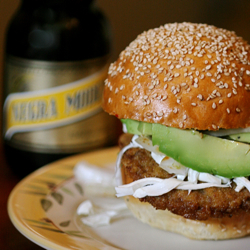
The ones we’re enjoying as our Cinco de Mayo treat are filled with the homemade chicken-fried-steak called milanesa, arguably the most-popular cemita filling. But if you’ve got some carnitas or tinga left over from your own festivities, I guarantee they’ll find a happy home between two halves of a sesame-seed bun.



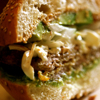
Cemitas Poblanas de Milanesa
1 pound beef sirloin tips, pounded thin
1/2 cup flour, seasoned with 2tsp salt and 1tsp pepper
1 egg, well scrambled with 1T water
1/2 cup fine breadcrumbs
oil for frying
—–
4 challah rolls, preferrably sesame seeded
1 mild white or red onion, sliced thickly
8 oz panela or queso de Oaxaca, or other fresh and creamy Mexican cheese
your favorite mexican salsa roja (the cooked smooth sort, not like pico de gallo)
– or substitute a few pureed chiles chipotles en adobo thinned with water or vinegar
2 large avocados, peeled and sliced
16 sprigs of papalo (or substitute cilantro)
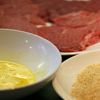
Pound the meat flat with a meat tenderizer, 1/4-inch or thinner, and pat dry with a paper towel. If the pieces are larger than sandwich size, you may want to cut them apart. Dredge the meat in the seasoned flour, brushing off any excess until just the thinnest layer remains. Dip quickly in the egg, again taking care to leave as little as possible on the meat, and then a light layer of breadcrumbs.
In a deep skillet, add sufficient oil to shallow-fry at a depth of 1/4 inch. (In my 10-inch skillet, I used about 3/4 cup.) Heat the pan over medium heat until oil is shimmering but not smoking. Place the breaded meat in the pan and fry until golden brown on both sides, just a few minutes total. Remove from the pan and keep warm on a cooling rack in a warm oven.
Cut the buns in half, and lightly toast under a broiler or on a griddle. While buns are toasting, coarsely smash 1/3 of the avocado in a bowl with the back of a fork. Spread the mashed avocado on the bottom of each bun, and season with salt. Pour the salsa onto a small saucer, and dip the top half of each bun into the salsa to coat; set aside. Top the bottom half of the bun with a piece of the milanesa, followed by cheese, onions, papalo or cilantro, and the remaining sliced avocados, and the salsa-smeared top.
Something to drink?
– Margaritas: Drink of the Week 9/15/06
– Michelada: Drink of the Week 11/24/06
– Sangrita: Drink of the Week 6/1/07
holidays & occasions, meat, Mexican, travel
3 Comments »
Posted by Anita on 04.28.08 11:59 PM
 It’s been good year for lost ingredients. Obsessive cocktail geeks can now whip up once-impossible drinks, courtesy of newly minted versions of pimento dram, creme de violette, absinthe, and other revivals. And soon, sloe gin will join the ranks of the resurrected, opening up a new chapter of vintage cocktails to modern palates.
Nitpickers will counter that sloe gin was never truly lost. And yes, any well-stocked suburban liquor barn probably has a dusty bottle or two on hand for frat boys looking to whip up a batch of Alabama Slammers. But these so-called sloe gins are no more than low-quality, one-note wonders packed with sugar and artificial fruitiness; many don’t even start with a gin base. Truly, they’re so far removed from the real thing that most cocktail enthusiasts have considered sloe gin a lost ingredient Stateside, going so far as to concoct their own facsimiles from sour plum infusions or importing bottles from abroad.
But next month, all that will change: One of our favorite gin brands plans to launch their sloe-infused variety — previously available only in the UK and Australia — here in the US.
After what seems like an interminable wait, Plymouth Sloe Gin will make its North American debut in May, starting in bars and (one hopes quickly) moving into limited retail release. Through the good graces of a quick-thinking pal, I’ve found myself in possession of an exceedingly rare bottle a bit ahead of schedule. And so I did what any sane cocktail geek would do: I rounded up a crew of like-minded drinkers and got shaking.
To get a sense of what we were playing with, we tried a sip of the sloe gin on its own. The Plymouth press materials speak of “sweet cherry and raspberry notes that provide a complimentary mixture of figs, cloves, honey and stewed fruits”. But, truthfully, when tasted neat it’s hard to discern anything beyond a flavor wholly reminiscent of “the cough-syrup berry” (as one sharped-tongued wag remarked). We all agreed: This is a strong, tart flavor that wants to be mixed, not sipped.
Happily, there are a wealth of sloe gin recipes waiting in the world’s cocktail archives; CocktailDB alone boasts more than 90 of them, and every pre-Prohibition collection seems to sport a handful. Fans of bittersweet combinations — of which there were many in attendance at our sloe soirée — should head straight for the widely noted Blackthorn, a 2:1 sloe gin / sweet vermouth mixture stirred with a dash of orange bitters. It’s a surprisingly tasty pairing, especially when using a top-notch Italian vermouth.
But the unanimous favorite of the evening came straight out of the venerable Savoy Cocktail Book, a harmonious blend of “five ingredients… downright complicated for the Savoy” (quipped the guy who should know). With Jamaica rum and apricot brandy, the flavors are almost tiki-like. But the sour bite of the lime juice and the dark sweetness of the rum are a perfect foil to balance out the sloe’s medicinal qualities.



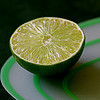

Millionaire Cocktail (No. 1)
juice of 1 lime
3/4 oz sloe gin
3/4 oz apricot brandy
3/4 oz Jamaican rum
1 dash grenadine
Shake well and strain into cocktail glass.
Drink of the Week, drinks, other blogs, recipes
11 Comments »
Posted by Anita on 04.22.08 5:01 PM
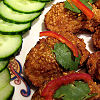
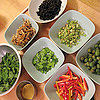
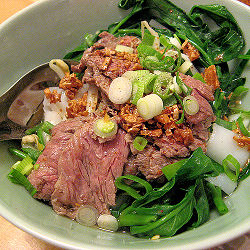 At this very moment, I’m on my way to Oakland for the last session in my third series of advanced classes with Thai cooking expert Kasma Loha-unchit, the award-winning author of It Rains Fishes and Dancing Shrimp. Since it takes a year or more to complete the prerequisite classes — and chances are good you’ve heard me rave about Kasma before — I won’t torture you with the details of the truly delicious food we’re making …although you’re welcome to peek at the photos on Flickr, or check out my last class recap of Series B.
But… if you’re interested in starting down your own path to culinary liberation (and really, who doesn’t want to be able to cook better Thai food at home than you can buy at any restaurant outside of Thailand?) you’re finally in luck. Kasma’s just this morning opened up three new Beginning Thai Cooking series for fall 2008:
September – Mondays, Sept. 8, 15, 22 & 29
– Tuesdays, Sept. 9, 16, 23 & 30
October – Mondays, Oct. 6, 13, 20 & 27
(There’s also a single Intermediate series and a single Advanced set, but I’m presuming that anyone who’s met the prerequisites for these has already gotten word of them.)
Each 4-session series costs $175, which includes 16 hours of hands-on instruction and full meals. More details about the classes — including menus — can be found on Kasma’s site, Thai Food and Travel.
But do hurry: The beginning classes, especially, fill up faster than you can say “bpoo pad pritkai dâm pkap kreuang tehd” (or even “Black-Peppered Crab with Roasted Spices”… ) Send a request to hold your space to kasma[at]earthlink[dot]net, and be sure to send along second- and third-choice dates to avoid disappointment.

classes, East Bay, Thai
8 Comments »
Posted by Anita on 04.18.08 11:15 PM
 H. Joseph Ehrmann is a busy guy. He runs a full-service cocktail catering company, maintains a successful spirits consultancy, serves as a brand ambassador for Square One organic vodka, and promotes Green & Tonic to help bar owners adopt environmental improvements.
As if he weren’t busy enough, H. is also one of the panelists this year at Tales of the Cocktail, co-presenting a session about green bars and seasonal cocktails — hence my interest in tracking him down. But first and foremost, he’s the proprietor of Mission District stalwart Elixir, San Francisco’s second-oldest saloon.
If you’ve walked by Elixir’s vintage facade on the corner of Guerrero and 16th streets, you might have mistaken it for just another neighborhood bar. And you wouldn’t be wrong, really: The local crew are all there, complete with a gaggle of beer-and-a-shot mooks shooting darts, and docile dog welcoming patrons at the door. But scratch the surface of this time-worn tavern and you’ll find a few surprises.
First, that beer: As likely as not, it’s local, organic, or at least sustainably produced. There’s always at least one all-organic cocktail on the Elixir menu, and often a fruit-based seasonal special as well. And the bar itself was actually the first watering hole certified as a green business by the City of San Francisco, which monitors Elixir’s energy usage, recycling and composting efforts, and a host of other sustainability criteria.
I caught up with H. — nobody’s called him Harold since high school — at one of the Mixology 101 classes he leads at a chain of Peninsula-area athletic clubs. (They’re offered as a membership perk, although civilians are quite welcome.) Along with an enthusiastic gaggle of newbie bar-enthusiasts, I stirred up a space-age martini, muddled a mojito, shook up an all-organic Margarita, and learned how to flame an orange peel to garnish a classic Manhattan.
The last drink of the night, the punnily named Country Thyme, introduced our budding mixologists to fresh-produce cocktails. Amusingly, I’d actually attempted to order this very drink the previous night on a trip to Elixir, only to find there were no berries on the premises. (H. laughingly explained he’d hijacked the bar’s stash for a catering gig, and absentmindedly forgot to replace them.) The drink’s vibrant hue and patio-perfect looks make it a crowd pleaser; H says as soon as the first one makes its way across the room, everyone’s bellying up to the bar asking for their own.
If all this talk of sustainable, market-fresh ingredients is making you thirsty, a trip to Elixir might be in order. And there’s no time like the present: Next week, H. plans to roll out his newest seasonal cocktail list, full of plenty of mid-spring treats from the farmers market.






It’s a little early yet for blueberries, but if you’re looking for a 100%-organic cocktail to celebrate Earth Day, there aren’t a ton of fresh-fruit options at this time of year. My preference here would be frozen Northwest blueberries, a better option than the flavorless South American imports. In places where organic strawberries are already available, consider that substitution; you’ll lose the magenta color, unfortunately.
Country Thyme
– courtesy H. Joseph Ehrmann, Elixir
1/3 cup organic blueberries
1 organic lemon
1/2 oz organic agave syrup (or 3/4 oz simple syrup)
1.5 oz Square One vodka
2 sprigs organic thyme
Muddle the blueberries in the bottom of a mixing glass. Cut the lemon into chunks — about 8 pieces — and muddle in the glass with the berries. Add the agave syrup and the vodka, and shake vigorously.
Spank one sprig of thyme, place it upright in a highball glass, and fill the glass to the rim with ice. Strain the shaken mixture into the glass, and garnish with the remaining sprig of thyme and a straw.
—
PS: Stay tuned to the Tales Blog for my preview of H.’s session, The Green Seasonal Bar.
bar culture, classes, Drink of the Week, drinks, locavore, Tales of the Cocktail
7 Comments »
Posted by Anita on 04.18.08 8:09 PM
 When I read that Shuna Lydon was teaching her legendary pastry tutorial — a class that, by her own admission, she’s taught so many times she’s lost count — I leapt at the chance to sign up. The last time I had the pleasure to learn at her elbow, I picked up countless little tricks for making outrageously tasty seasonal fruit desserts.
This time out, I finally learned why my usual pie-dough recipe is fine for savory applications like quiche, but not so hot for desserts. I got to see and feel where I’d been going wrong in my previous pie-making expeditions. As a side benefit, I got to hole up inside a breezy commercial kitchen on one of the hottest days of the year, relaxing into the busy charm of a kitchen full of women. Perhaps best of all, though, I got to come home with one seriously gorgeous pie crust for my troubles.
As I carefully ferried my flaky cargo across the bay in an insulated bag, visions of oozy pastry goodness danced before my eyes. But as bountiful as our spring produce is here already, we’re in that awkward in-between stage, fruit wise. It’s too late for apples, way too early for blackberries. Strawberries are coming into season, but I don’t really like them cooked. I’d hoped to have enough lemons off of our tree by now to attempt a lemon meringue, but you can’t rush Mother Nature. So I dusted off the cookbooks and went looking for options.
There it was, smack in the middle of my 1961 edition of The Joy of Cooking. A long-forgotten childhood favorite, that humble all-American dessert known as black-bottom pie. Line a simple pastry crust with chocolate custard (or ganache, if you’re feeling modern and fancy), cover with a rum-kissed custard, and top with whipped cream. Even with the cheapest ingredients, it’s indisputably delicious, even if a bit homely. When made with top-drawer bittersweet chocolate, pastured eggs, and the best dairy you can find, this simple combination turns into a dessert worthy of a pastry chef’s crust.
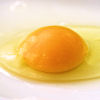
I separated four Marin Sun Farms eggs, and right away I could tell I was in for a treat. These eggs are always delicious, but some weeks — especially in the winter — they’re not especially gorgeous. These were a sure sign of spring: Yolks so yellow they were almost-orange standing proudly atop solid whites. Separating them felt almost cruel, as each half clung tenaciously to the other.
Cooking the custard until it was thick enough to coat the back of a spoon took mere moments — not the 20 minutes that Mrs. Rombauer instructed. Whipping the whites (to fold back into the custard) was equally swift: Even using a wimpy hand-held mixer, they flew right past soft peaks and into firmness in a matter of seconds. When yolks and whites were reunited, the resulting rum chiffon stood high in the bowl without the usual gelatin stiffener.
And the taste? Oh, my… so decadent. I can’t give away all of Shuna’s pie-crust secrets — though they’re there for the taking if you know where to look.




Black-Bottom Pie
1 pie shell, blind baked and cooled to room temperature
1/2 T (approx. 1/2 packet) gelatin*
2 cups whole milk
1/2 cup sugar
4 tsp cornstarch
4 eggs, separated, with 1 white discarded
1-1/2 oz unsweetened chocolate, grated or shaved
1/2 tsp vanilla
2 T white rum
1/4 tsp cream of tartar
1/4 cup sugar
1 cup whipping cream
2 T confectioners sugar
1/2 oz bittersweet chocolate, for shaving
If using gelatin, soak in 1/4 cup cold water and set aside. Scald the milk. In a small bowl, add the sugar and cornstarch, and whisk gently to combine; set aside. In a medium metal bowl, whisk the egg yolks until light in color. Slowly stir the hot milk into the eggs with a wooden spoon or heatproof spatula, then add the sugar mixture.
Bring a cup or two of water to a simmer in a medium saucepan. When you’ve reached a stable, steady simmer, place the metal bowl over the steam to cook the custard. Make sure that the water is not touching the bottom of the bowl; you’re cooking with the steam, not by direct water contact. Stir constantly with the spoon or spatula, making sure no hot spots develop. The custard is ready when it thickly coats the back of the spoon; this can take anywhere from 5 to 20 minutes, depending on the freshness of your eggs, the thickness of the bowl, and the speed of your simmer.
Place the grated unsweetened chocolate in a medium bowl. When the custard is done, immediately measure out 1 cup of the cooked custard into the bowl of chocolate, and stir until the chocolate melts and combines with the custard. Add the vanilla and a pinch of salt, and stir to combine. Pour the chocolate into the prepared pie shell, spreading evenly around the bottom.
If using gelatin, add it to the remaining custard while still warm, then add the rum; stir all until combined and the gelatin completely dissolves.
Using a stand mixer or electric hand mixer, beat the egg whites until stiff but not dry. Continue to mix while gradually adding the granulated sugar, a teaspoon at a time to keep from deflating your eggs.
Fold the whipped egg whites into the custard. Add the rum custard to the pie shell atop the chocolate layer, and chill the entire pie until set (about an hour).
When ready to serve, whip the cream to stiff peaks, then add the confectioners sugar. Cover the custard layer with whipped cream, and garnish with chocolate shavings or chocolate curls.
Pie will keep, in the fridge, for a couple of days.
—–
* Note: Most recipes call for a full packet of gelatin, which I find makes for a very firm, almost artificial-feeling chiffon. You can reduce it to half that amount, as noted here, to keep the texture less spongy. If you want the pie to be strictly vegetarian, the gelatin is optional providing that you’re using very fresh eggs, that you don’t stint on fully whipping them to stiff peaks, and that you don’t mind your custard layer being a little loose. (I actually prefer it this way myself.)
Also, the egg whites are essentially raw here, so the usual food-safety caveats apply.
—–
This little slice of yolk-yellow love also happens to be our entry for A Taste of Yellow, a blog event now entering its second year. Hosted by Barbara of Winos and Foodies, A Taste of Yellow features entries from food bloggers around the world — last year’s inaugural edition boasted 149 entries! — in support of LiveSTRONG Day, the Lance Armstrong Foundation‘s initiative to raise awareness and funds for the cancer fight.
 We dedicate our Taste of Yellow post both to our hostess Barbara, in her ongoing efforts to remain cancer-free, and to our friend Briana. Many of you know her blog, Figs with Bri, where she posted Wednesday about her recent setback: breast cancer has metastasized to her lungs. Since then, her site’s gone dark and her email account is offline. We’re keeping Bri and her husband Marc in our thoughts and prayers, and hoping for the very best.
baking, classes, dessert, East Bay, other blogs, recipes
10 Comments »
Posted by Anita on 04.07.08 4:22 PM
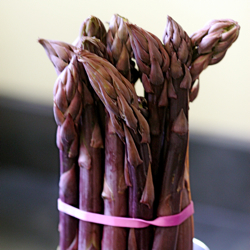 I think it’s safe to say that by any objective measure, Dark Days are well behind us here in San Francisco. Asparagus has been on the farm tables for a month, strawberries made their Ferry Plaza debut this Saturday, and — hooray! — the first pasture-raised chicken of 2008 made its way into our bag (and our bellies) yesterday.
Spring has indeed sprung. And with the dawning of a new season comes the end of the Dark Days Eat Local Challenge.
I know you probably won’t be shocked to hear that April 1 didn’t look a whole lot different in our kitchen than March 31. We’re not going to stop hunting down locally produced foods just because we aren’t documenting every last morsel, after all. Three of the last five dinners we’ve eaten have been made with 100% local ingredients, so I think we’re safely launched down this particular path.
 And for that, I owe huge debt to Laura — for dreaming up Dark Days, for hosting the weekly roundups last fall, and for extending the challenge into 2008 when we all clamored for more. I can only imagine how she manages her own blog and handles her roundups of every Dark Days blogger in the country, all while moving onto her new farm, raising a new brood of chicks, and working a full-time job. (Honestly, I’m exhausted just thinking about it…) I know in my heart that we’d never have dug as deep into our food chain if it hadn’t been for the thrill of the challenge, and knowing we had a built-in audience of Dark Days participants who would share our excitement.
Although we’ll stop with our periodic Dark Days wrap-ups, you haven’t heard the last of our locavore ways. In fact, I had high hopes of debuting a new “Bay Area Pantry” page this weekend, showcasing all the products we’ve found that are grown or produced within our foodshed radius. The good news is that it’s 90% ready; the bad news is that time ran out on me, and the final Dark Days roundup must go on, with or without me. I still need to add some links, photos, and section headings, but I’ll let you know when the pantry is fit for public consumption.
In the meantime: Here’s to spring — Let the asparagus-gorging begin!



Dark Days Ticker — March 16-31
– Dark Days dinners at home: 9 out of 16
– Locavore dining-out: MÅno, O Izakaya, Marin Sun Farms butcher shop / tour lunch
– New recipes: Reuben sandwiches, feta-stuffed lamb burgers, English muffin bread
– Old faves: Not-Spam and Eggs, choucroute garnie, gumbo, beef stew, Thai beef salad
– Freezer fodder: A16 meatballs, beef stew, Mamster’s carnitas, pasta bolognese
New local items in the pantry:
Middle Eastern Baking lavash (Millbrae)
Hamati pita (San Bruno)
Sconehenge English muffins (Berkeley)
Achadinha brined goat feta (Petaluma)
Fatted Calf sauerkraut, andouille, bockwurst, pastrami (Napa)
Marin Sun Farms slab bacon (Point Reyes)
Alexander Valley Gourmet sauerkraut
cooking, Dark Days challenge, locavore, other blogs
6 Comments »
