Posted by Anita on 03.19.10 11:06 PM
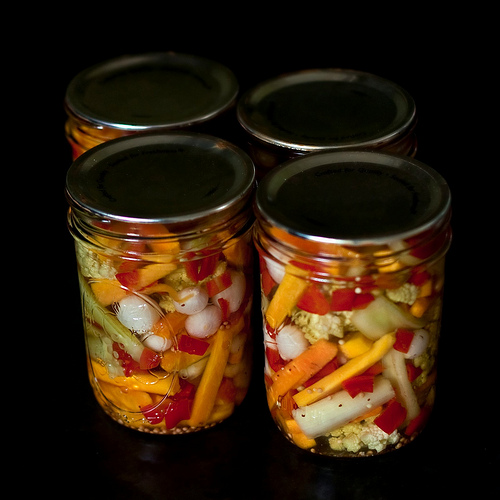 Trying to plan a suitable entry for this month’s CanJam — the theme is alliums — left us a little perplexed. It’s not that we haven’t been known to preserve onions: I’m a big fan of the bright-pink Yucatecan pickled onions served with cochinita pibil, and Cameron has a special fondness for English-style pub onions.
But because we prefer them very crisp, we usually make both of these recipes as refrigerator pickles. (Processing seals the jars and kills any lingering toxins, but it also cooks whatever’s in the jar.) Neither of us really cares for sweet condiments with our savory dishes, so onion jams were out.
Then it occurred to me: Giardiniera.
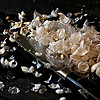
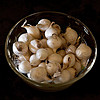
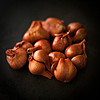
Now, strictly speaking, onions are just one of this Italian-style pickle’s many components, but the little devils take an ungodly amount of time to prep, way more than all of the other parts combined. First you have to slice off the hair-like root end, but oh-so-carefully so as to not dislodge the onion’s layers from one another. Then you have to peel each tiny onion — no mean feat when natural sugars keep papery skins adhered firmly to outer layers of the onion’s flesh — without cutting them in half or otherwise mangling them.
It’s a labor of love, I tell you, but it’s all worth it when you open up that first jar and taste. The onions are integral part of giardiniera, the linchpin of its piquant flavor.
Giardiniera means “gardener” in Italian, the implication being that this hodgepodge of different vegetables would be a great way to preserve the bounty of an active kitchen plot. But its traditional components — red peppers, carrots, celery, onions, and cauliflower — are never simultaneously seen in abundance in any garden I’ve ever known. Even in Italy, I think you’d be hard-pressed to find red peppers and cauliflower in the same patch. (I did a little research on how this seasonal impossibility got its start, and came up empty; if anyone knows how these ingredients ended up in a single pickle, I’d love to hear!)
Other than the peppers, though, we’re able to get everything we need from our own garden, or nearby farmers, even in late winter. In place of the bell peppers, I used a bunch of skin-on piquillo peppers I’d stashed in the freezer last summer, but added them to the mixture just before portioning the cooked vegetables into the jars, to avoid softening them any further. Their texture wasn’t so hot, but they’re mostly there for color, anyway. Next year, I might just — shhh! — buy an imported pepper or two.


Giardiniera (Italian-style Pickled Vegetables)
— adapted from Sunset Canning, Freezing, and Drying
1/2 pound carrots*
1/2 pound celery*
2 red bell peppers
1 large cauliflower or romanesco
1 pound small white pearl onions
1 cup pickling salt
2 quarts white vinegar
1/4 cup mustard seed
2T celery seed
1 small dried hot pepper
1-1/2 cups sugar
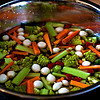
Peel carrots, then cut into 1-1/2-inch by 1/4-inch sticks; you should have about 4 cups*. Remove strings from the celery, then cut into into 1-1/2-inch by 1/2-inch planks; you should have about 3 cups*. Stem and seed the peppers peppers, then cut into wide strips. Break the cauliflower into florets; trim the stems. Carefully peel the onions, leaving the root intact. Try not to swear.
In a very large bowl, dissolve the pickling salt in 4 quarts cold water. Add the vegetables to the brine, and refrigerate for 12 to 18 hours. Drain the vegetables, rinse in cold water, and drain again.
Prepare canner, lids, and 6 pint jars according to the usual method.
 Combine the vinegar, mustard seed, celery seed, chili pepper, and sugar in a 6-quart stainless or enamel pan. Bring to a boil and continue to cook for 3 minutes. Add the vegetables, reduce heat to low, and cook for a few minutes until the vegetables just begin to soften. Remove from heat and discard the chili.
Using a funnel, pack vegetables into hot jars up to just shy of 1/2 inch of the rim. Ladle hot pickling liquid to cover vegetables, leaving 1/2-inch headspace.
Remove air bubbles and adjust headspace; wipe rims and apply lids and rings.
Place jars in canner, ensuring they are completely submerged. Bring to a boil and process covered for 5 minutes. Remove canner lid; wait 5 minutes, then remove jars. Cool, check for seals, and store in a cool, dark place for up to a year.
—
* Note: After reading comments from a friend and long-time reader, I suspect that my weight-to-volume measurements are incorrect here. Please see this comment and this follow-up.
CanJam, Italian, locavore, preserving & infusing
10 Comments »


Posted by Anita on 03.17.10 9:46 AM
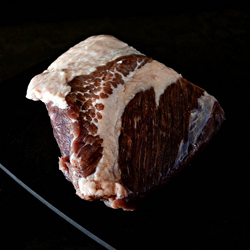 Every St. Patrick’s day we wonder: How did we let another year go by without making corned beef with all the trimmings? It’s simple, affordable, and delicious — too good to save for the holiday celebrations.
Sure, you can buy your corned beef at the market, but if you’d rather make your own using local meat and ingredients you can trust, it’s not difficult to brine it yourself. All it takes is a few minutes of measuring, a week of waiting, and a bit of refrigerator space.
We’ve made a number of recipes over the years, but the one we keep coming back to is the simplest. Hugh Fearnley-Whittingstall’s corned beef recipe serves 10 in its original ratios, so we’ve scaled it down to a more manageable size. If you do end up with extra meat, you’re in luck: In my book, corned-beef hash and Reubens are right up in leftovers heaven alongside the meatloaf sandwich.
Many recipes call for curing salt, but its only purpose is to maintain the pink-red color of the meat; it doesn’t serve any preservative purpose in corned beef, so we usually leave it out. (In charcuterie, it’s a necessary ingredient, but here it’s just for looks.) If you prefer the traditional blush, add 2 tsp of pink curing salt — also known as sodium nitrite or Insta Cure #1 — to the brine.
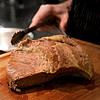
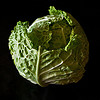

Corned Beef and Cabbage
– adapted from The River Cottage Meat Book
3 to 3-1/2 pounds well-marbled brisket
—
* for the brine:
2-1/2 quarts water
8oz demarara or light brown sugar
1-1/2 pounds coarse sea salt
1/2 tsp black peppercorns
1 tsp juniper berries
3 cloves
2 bay leaves
a sprig of thyme
—
* for cooking:
bouquet garni
1 carrot, chopped
1 onion, chopped
1 stalk celery, chopped
4-6 cloves garlic
—
* at the end:
3-5 large carrots, cut into large chunks
1 medium head cabbage, quartered, leaving core intact (or 4 small heads, halved)
5-10 potatoes, halved
2-3 turnips (optional), halved or quartered
Put all the brine ingredients in a medium saucepan and stir well over low heat until the sugar and salt dissolve. Bring to a boil, then remove from heat and let cool to room temperature.
Place your brisket in a large, non-metallic container (we use a large zip-top bag, but a deep casserole works well, too). Cover the meat with the cooled brine; weigh it down with a saucer or other non-reactive object if it floats (not necessary with the bag). Leave in the refrigerator for 5 to 7 days, turning every couple of days.
The day before you want to cook the corned beef, remove the brisket from the brine and soak it in cold water for 24 hours, changing the water at least once.
After the soak, place the brisket in soup pot with the bouquet garni, chopped vegetables, and garlic. Cover with fresh water and bring to a gentle simmer. Poach gently on top of the stove (or in a 275°F oven) until tender, about 3 to 3-1/2 hours. (A good test is to run a metal skewer through the meat; if it slides in easily, your brisket is done.) About 30 minutes before the brisket is done, add the remaining vegetables and simmer along with the meat.
Serve the hot corned beef cut into thick slices, along with the simmered vegetable chunks. (You can discard the smaller chopped vegetable bits in the broth.) Serve with fresh horseradish cream at the table.
 Farmers and food artisans who created the ingredients for this week’s meal:
Prather Ranch, MacDoel: brisket
Catalán Family Farm, Hollister: onion, celery
Dirty Girl Produce, Santa Cruz: carrots, cabbage
Little Organic Farm, Marin: potatoes
Iacopi, Half Moon Bay: garlic
Happy Girl Kitchen Co., Big Sur: prepared horseradish
Clover Organic, Petaluma: sour cream
…and our own homegrown bay and thyme
Exemptions: sugar, peppercorns, juniper berries, cloves
Dark Days challenge, holidays & occasions, locavore, meat
8 Comments »
Posted by Anita on 03.15.10 9:48 PM
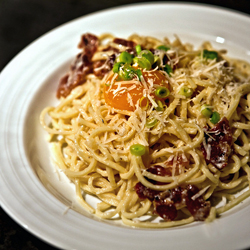 When you stock your larder with good quality staples, you’re able to create some amazing, quick weeknight meals. We’re lucky to live in a part of the country with access to a year-round supply of pastured eggs, a wide assortment of local artisan-made cheeses, and some truly excellent dry pasta, all from local sources.
We’re also blessed to have good friends with amazing food-crafting skills. A case in point: Our friend Sean made his own house-cured guanciale, and generously gifted us with a chunk of the most delicious pork product we’ve tasted in recent memory.
Although Laura’s birthday dinner last Sunday could technically have been my Dark Days Challenge dinner for the week, I felt pretty happy knowing we’d be able to throw together an all-local meal, even though I’d missed the weekly farmer’s market during my Seattle trip. With Sean’s home-cured guanciale in our stash, along with a fresh dozen eggs from last week’s Soul Food Farm CSA delivery, we were only a few ingredients away from one of Cameron’s favorite simple suppers.
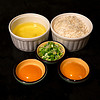
Two things set this pasta carbonara recipe apart from the usual. First, we added slivered green garlic as a garnish, an embellishment that’s sure to be frowned upon by carbonara purists, but one we’ll keep making as long as Knoll Farms keeps supplying our weekly fix. The second innovation is simple but revelatory: Separating the eggs and stirring the hot pasta with just the whites, then topping each serving with its own yolk to be stirred in at the table. This small trick lends the sauce a silky quality, and adds a little flair to the proceedings — just the trick for making a quick midweek supper worthy of an ingredient that took weeks to make.
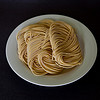
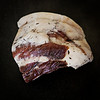

Spaghetti alla Carbonara
— adapted from Molto Italiano
1-1/2 T extra virgin olive oil
4oz guanciale (or pancetta)
1/2 pound spaghetti
3/4 cup freshly grated Parmesan
2 large eggs, separated
1 green garlic, white and light green parts, sliced thin
freshly ground black pepper
In a large pot, bring 4 quarts of well-salted water to a boil. Meanwhile, cut the gianciale into flat pieces, then combine the olive oil and guanciale in a large skillet over medium heat. Cook until the guanciale has rendered its fat, and becomes juicy and lightly browned. Remove the guanciale to a plate; remove the pan from the heat and set aside, reserving the fat in the pan.
Cook the spaghetti in the boiling water until just al dente. Add a good spoonful of the pasta water to the pan with the guanciale fat; drain the pasta. Return the guanciale to the pan, then add the pasta. Turn the heat back to medium-high and shake/toss the pasta with the water, fat, and guanciale for about a minute. Remove the pan from the heat and add 1/2 cup of the cheese, the egg whites, and freshly ground black pepper to taste; toss until thoroughly mixed (the egg whites will cook from the heat of the pasta).
Divide the pasta into nest-like piles between two warmed pasta bowls. Gently slide an egg yolk into the middle of each nest, then season with more pepper, the rest of the cheese, and the green garlic. Serve immediately, allowing each diner to stir the yolk into their own serving.
Farmers and food artisans who created the ingredients for this week’s meal:
Guisto’s Vita-Grain, South San Francisco: sea salt
Bariani, Sacramento: olive oil
Hedonia, San Francisco: guanciale (from Prather pork jowls)
Eduardo’s, San Francisco: spaghetti
Spring Hill Cheese Company, Petaluma: dry Jack cheese
Soul Food Farm, Vacaville: eggs
Tairwa Knoll Farms, Brentwood: green garlic
exemptions: black pepper
Dark Days challenge, Italian, locavore, meat, other blogs
3 Comments »
Posted by Anita on 02.28.10 5:33 PM
 I used to work with a woman who brought in a sleeve of bagels, a tub of cream cheese, and a carton of orange juice every Monday. She parked them in the office fridge and then religiously ate the identical breakfast every morning, for weeks, months, years.
Just the memory of it makes me a bit twitchy, but also more than a little envious — think of how much time I could save if I could be content with monotony! But though I crave familiarity as much as the next person, I could never be one of those people who eats the same thing over and over, day in and day out. Heck, I can barely stand to repeat a dinner menu more than monthly.
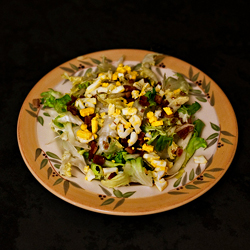
So you can imagine my surprise when I found myself craving — and then making — the same salad three times in two weeks. Originally, the recipe appealed because I found myself the proud owner of three heads of escarole, courtesy of our latest Mariquita Farm mystery vegetable box. I’d intended to use this broad-leafed chicory in a variety of recipes: in Zuni bread salad, in brothy Italian sausage soup, and sauteed simply and scattered with pine nuts. But once I’d tasted this salad, I couldn’t stop making it.
It bears more than a passing resemblance to salade lyonnaise — that heavenly mixture of pleasantly bitter frisée and thick lardons of bacon, crowned with a poached egg — but requires a lot less fuss. You can boil the eggs and fry the bacon hours ahead of time, then whip everything together when you’re ready to serve. And it’s interesting enough to hold its own, or sit happily alongside a simple main course like the roast chicken we made for this week’s Dark Days Challenge dinner.


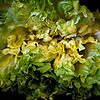

Warm Escarole Salad
Рadapted from Bon App̩tit
1 small head of escarole, torn into bite-size pieces (about 4 cups)
1 large slice bacon
1T extra-virgin olive oil
1T balsamic vinegar
3T finely chopped shallot
1 hard-boiled egg, diced
Over medium heat, cook the bacon until just crisp. Remove to paper towels, reserving the bacon drippings in the skillet. Chop bacon and set aside.
In a small bowl, whisk olive oil and vinegar together. Reheat the bacon drippings in the skillet; add shallots and sauté until slightly softened but not browned. Add olive oil mixture and stir until heated through. Season to taste with salt and pepper.
Divide escarole between two plates, and drizzle warm vinaigrette over the top. Sprinkle with egg and bacon, and serve warm.
Farmers and food artisans who created the ingredients for this week’s meal:
Mariquita Farm, Watsonville: escarole
Shasta Valley Farm, Gazelle (via Live Culture): bacon
Bariani, Sacramento: olive oil & vinegar
Dirty Girl Produce, Santa Cruz: shallot
Soul Food Farm, Vacaville: eggs and chicken
Guisto’s Vita-Grain, South San Francisco: sea salt
exemptions: black pepper
Dark Days challenge, locavore, recipes
4 Comments »
Posted by Anita on 02.22.10 12:12 PM
 I find it fascinating how some recipes languish in my clippings folder for months, years even, before I set my mind to trying them. It’s not that they don’t sound appealing — clearly they do, or I wouldn’t have bothered putting them aside — but maybe the moment’s not right, the ingredients aren’t at hand, the quantities are best saved for a party.
Not every recipe gathers dust, though. Some send me sprinting to the kitchen as soon as I read them. And our friends Michael and Jen’s deep-dish pizza is one that I absolutely had to try right away.
I saw the original version of the recipe on Jen’s blog, Last Night’s Dinner, almost a year ago. We made it ourselves fairly soon thereafter, and we liked it. But we’re rather set in our pizza-making ways here, generally leaning toward thin-crust Italian-style pies when we decide to go the home-pizzeria route. Seeing Jen’s photos of Mike’s latest tweaks to his deep-dish recipe reminded me that we have a giant stash of Italian sausage waiting in our freezer, and got me thinking how well it would complement a sauce made from last summer’s home-grown tomatoes for this week’s Dark Days Challenge meal.
We gave Mike’s new edition a try — actually two tries in one week, that’s how much we like it — and weren’t surprised that it’s even better than the original pie. I made a few tweaks to the crust to adjust it to our taste; unfortunately, these changes turn Mike’s relatively painless recipe into a process that’s less convenient for weeknight preparation, so you may very well prefer his streamlined version. I often like to make and rise my pizza dough after dinner on one night, then tackle the second rise on the next. If your schedule’s a little more compressed, you can quick-rise the dough — as Mike’s master recipe does — and the end result will still be very, very good.
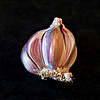
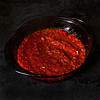

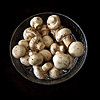

Deep-Dish Pizza
Adapted from Last Night’s Dinner, with crust tips from American Pie
– Crust
2 tsp active dry yeast
1 tsp sugar
1C warm water
3T unsalted butter, softened
1tsp table salt or 2tsp kosher salt
3C unbleached AP flour [15oz]
Grease a medium bowl with olive oil and set aside. In the bowl of a stand mixer fitted with a dough hook, combine the yeast, sugar, butter, and water; let sit 5 minutes or until frothy. Add the flour and salt, and combine at low speed. Increase speed to medium and mix until the dough pulls away from the sides of the bowl and crawls up the dough hook, about 1 minute. Add 1 to 2 tablespoons water if dough is dry; add 1 to 2 tablespoons flour if dough is wet. Continue to knead (in the mixer, or by hand) until dough is silky smooth and passes the windowpane test.
Form the dough into a ball and place in the oiled bowl, turning to coat all sides of the dough ball with oil. Cover with plastic wrap and let rise until it doubles in bulk, about an hour. Punch down, reshape, and let rise again (covered) in the refrigerator, at least 2 hours or overnight. Bring the dough back to room temperature 2 hours before you plan to roll it out. (You can also use the dough immediately after the first rise, or even let it complete the second rise at room temperature, but the texture and taste will be better if you proceed with the second, slower rise.)
– Sauce
1T extra-virgin olive oil
1 small onion, peeled and diced
2 cloves fresh garlic, peeled and sliced
2T shredded carrot
1-1/2 T chopped fresh thyme
a 28oz can of whole peeled tomatoes, crushed with your hands
1/4 C red wine or port
salt, to taste
In a medium saucepan, heat olive oil over medium heat. Add onion and a pinch of salt; sauté until soft and golden, then stir in garlic and cook until soft. Add carrot and thyme and continue cooking until the carrot is soft.
Add tomatoes and their juice, plus wine. Lower the heat and cook until the sauce is thick, about 30 minutes, seasoning to taste as you go.
– Finishing
1 recipe crust
1 recipe sauce
1/2 lb Italian sausage
2T olive oil
3/4 to 1 pound button mushrooms, quartered
8 oz mozzarella (if fresh, torn into 1-inch pieces; if drier, shredded — we like half and half)
1/2 cup freshly grated hard cheese (such as Dry Jack or Parmesan)
1/2 cup fresh basil or spinach leaves, chiffonade
Preheat the oven to 400°F.
Heat a 12-inch cast-iron skillet on the stove over medium heat. Add 1T olive oil and crumble Italian sausage into the skillet. Brown, adding more olive oil if needed, until cooked through. Using a slotted spoon, remove the sausage to a plate lined with paper towels, leaving the fat in the skillet. (If your sausage is on the fatty side, you might remove some of the fat, but be sure to leave the skillet well greased.)
While sausage is cooking, saute the mushrooms in a large skillet: Heat 1T olive oil over medium heat, then add the mushrooms and saute until they lose their liquid. Salt if desired, and set aside.
Pat or roll the room-temperature dough into a circle about 12 inches in diameter. Let rest for 5 minutes — this will help keep the crust from shrinking — then transfer it to the skillet. Press dough down into bottom of skillet and partway up the sides. Drizzle a little olive oil over the crust, then layer the sauce, sausage, mushrooms, and mozzarella. Bake on bottom rack of oven for 30 minutes. Start checking the pizza for doneness; you want the pizza crust to be golden brown, and the toppings to be just starting to brown. Remove pizza from oven and top with grated cheese and basil.
Farmers and food artisans who created the ingredients for this week’s meal:
Spring Hill Cheese Company, Petaluma: butter
Guisto’s Vita-Grain, South San Francisco: sea salt, flour
Bariani, Sacramento: Olive oil
Catalán Family Farm, Hollister: onion
Iacopi, Half Moon Bay: garlic
Ottimino, Occidental: Rancho Bello Zinfandel (for sauce)
Shasta Valley Farm, Gazelle (via Live Culture): Mangalitsa Italian sausage
Far West Fungi, Moss Landing: button mushrooms
Belfiore Cheese Company, Berkeley: mozzarella
Vella Cheese, Sonoma: dry Jack cheese
Mariquita Farm, Watsonville: spinach
Anchor Brewing, San Francisco: beer
…and our own homegrown carrots, tomatoes, thyme
exemptions: yeast, sugar
Dark Days challenge, locavore, other blogs, recipes
7 Comments »
Posted by Anita on 02.19.10 8:02 AM
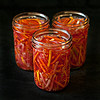
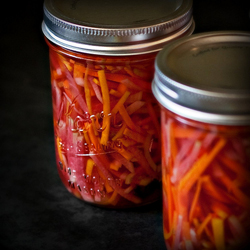 If you’ve ever wanted to try your hand at canning but held back because it seems complicated, consider getting yourself into a pickle.
Pickles are one of my favorite canning projects, because I am both lazy and messy. When dealing with simple brine — instead of the sticky goo of preserves, or the splattery plop of tomatoes — canning becomes almost too easy. You prep your vegetables, mix the pickling liquid, and put everything into jars. And because of most pickles’ high acidity, the chances that anything bad will happen during storage are practically nil. They’re the perfect beginner’s canning project.
The best part is, you don’t even have to wait until cucumbers are in season. Sure, those dilly spears are America’s favorite pickle, but canning books are jammed full of an international variety of vinegar-preserved vegetables. Even the bleakest winter farmers market usually has a decent assortment of root vegetables, and many of them — especially carrots and dense radish varieties — make excellent pickles.
If you’ve ever eaten the Vietnamese heaven-on-baguette sandwich known as banh mi, you’ve almost certainly enjoyed the type of pickle I made for this month’s edition of Tigress’s CanJam. Typically made with little more than carrots, daikon, ginger, vinegar, and salt, the version here adds star anise to give the julienned garnish a mysterious note.
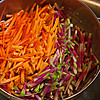
They’re rather on the sweet side, but that makes a nice foil for the meaty, salty goodness of their signature sandwich partner. As the canning gurus at Ball tell us, “The job will go faster if you have a mandoline to julienne the vegetables”. But I managed a half recipe using just a very sharp knife and a lot of patience.


Vietnamese Carrot and Radish Pickle
– from the Ball Complete Book of Home Preserving
3 C white vinegar
3 C filtered water
1-1/2 C sugar
2 tsp grated ginger (microplaned)
2 pounds carrots, 1/8-inch julienne
2 pounds dense radish (such as daikon or watermelon) 1/8-inch julienne
6 whole star anise
Prepare canner, lids, and 6 pint jars according to the usual method.
 In a large non-reactive saucepan, combine vinegar, water, sugar, and ginger. Bring to a boil over medium-high heat, stirring to dissolve sugar. Add carrot and radish; stir for 1 minutes, then remove from heat.
Place a star anise into each hot jar. Using a funnel, pack vegetables into hot jars up to just shy of 1/2 inch of the rim. Ladle hot pickling liquid to cover vegetables, leaving 1/2-inch headspace.
Remove air bubbles and adjust headspace; wipe rims and apply lids and rings.
Place jars in canner, ensuring they are completely submerged. Bring to a boil and process covered for 10 minutes. Remove canner lid; wait 5 minutes, then remove jars. Cool, check for seals, and store in a cool, dark place for up to a year.
CanJam, preserving & infusing, recipes
6 Comments »
Posted by Anita on 02.15.10 10:45 PM
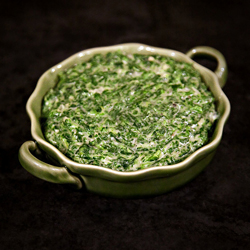 We hardly ever go out for big holidays like Valentine’s Day. It just seems so fraught, in so many ways. Somehow you always end up paying through the nose for a prix-fixe menu full of things that really aren’t what you’d want to order. And expectations are so high — not only because it’s everyone’s Special Night, but because, hey, you walked through fire to get that prime 8pm reservation — that there’s hardly any way a restaurant could rise to the occasion, much less impress.
So for as long as I can remember, we’ve chosen to stay in and cook ourselves a special meal. This year, we both decided we wanted a classic steakhouse dinner: A big, crisp salad with chunky bleu cheese dressing, a nice grilled ribeye big enough to share, a giant baked potato with all the fixins, a luscious ramekin of creamed spinach, and a special-occasion bottle of red wine.
With a little careful shopping, we managed to combine our romantic Valentine’s Day dinner for two with this week’s Dark Days Challenge meal — a wonderful match, if I do say so. Better still, we got to spend our evening cooking together, rather than circling endlessly looking for parking and jostling for a harried waiter’s attention.


Steakhouse-Style Creamed Spinach
– serves 2
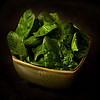
10oz fresh spinach
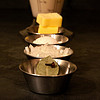
3T butter (divided use)
3T all-purpose flour
2T diced onion
1 small bay leaf
1 whole clove
2 C whole milk
pinch of nutmeg
Blanch spinach in large pot of boiling, well-salted water just until tender. Drain, then cool the spinach in a bowl filled with ice water. Drain well, then roll up spinach in kitchen towel and squeeze out as much liquid as possible. Transfer spinach to food processor and chop.
Melt 2T butter in skillet over medium heat. Add flour and stir until light golden. Stir in onion, bay leaf, and clove. Whisk in milk, stirring until mixture boils and thickens, about 10 minutes. Reduce heat to low and simmer, whisking frequently, until sauce is very thick. Remove bay leaf and clove, and add a pinch of nutmeg.
Add spinach to warm sauce. Simmer over low heat until spinach is heated through, stirring often. When ready to serve, stir in remaining tablespoon of butter, and season to taste with salt and pepper.
Farmers and food artisans who created the ingredients for this week’s meal:
Mariquita Farm, Watsonville: spinach
Spring Hill Cheese Company, Petaluma: butter
Guisto’s Vita-Grain, South San Francisco: sea salt, flour
Catalán Family Farm, Hollister: onion
Claravale Farm, Paicines: Raw milk
Little Organic Farm, Marin: potatoes
Clover Organic, Petaluma: sour cream
Prather Ranch, MacDoel: ribeye
Ottimino, Occidental: Rancho Bello Zinfandel
Star Route, Bolinas: Little Gem romaine lettuces
Point Reyes Farmstead Cheese, Pt. Reyes Station: Bleu cheese
…and our own homegrown bay and radishes
Exemptions: pepper, clove, nutmeg
Dark Days challenge, locavore, recipes
5 Comments »
Posted by Anita on 02.07.10 9:16 PM
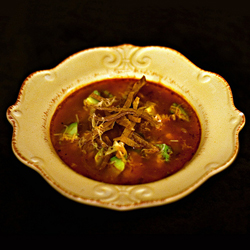 Yes, yes — soup again. I’d really hoped to have something better to share by the end of the week, but I’m still fighting the after-effects of a particularly nasty cold. Making dinner is doubly complicated: Not only do I not feel much like cooking, but I often have to trick myself into eating something I’m craving before my appetite disappears again.
Early last week, the only thing I could really get worked up about making was tortilla soup. We’re still at least a month away from local avocados at our farmers market, but I couldn’t imagine this classic soup without them. Sometimes it’s worth it, I rationalized, to make an exception for an ingredient that has no reasonable local alternative.
As luck would have it, Cameron found semi-local organic avocados at our co-op — California is better than Mexico, right? And we have plenty of local tomatoes in the pantry, so I didn’t have to venture too far off the local path to satisfy my sick-kid whims.



Sopa Azteca / Tortilla Soup
– adapted from Mexican Everyday
2 cups diced tomatoes in juice
2T ground pasilla or ancho chile
2T chicken fat (or mild vegetable oil)
3 garlic cloves, peeled
2 quarts chicken broth
1 large sprig epazote (optional)
2-1/2 cups cooked chicken, chopped or shredded
1 large ripe avocado, pitted, skinned, and cubed
6oz (about 1-1/2 cups) shredded mild cheese, such as asadero, Jack, etc.
6oz (about 4 cups) broken tortilla chips
1 large lime, cut into 6 wedges
Preheat the broiler. Drain the tomatoes, reserving the juice, and place on a parchment-lined rimmed cookie sheet. Broil the tomatoes until beginning to blacken; turn with a spatula and cook a little longer on the other side, until toasted and aromatic. Remove from oven and set aside.
Melt the chicken fat in a medium saucepan over medium-high heat. Add the onion and garlic and saute until softened. Add the ground chile and cook for another minute or two; be careful not to burn the chile — add water and/or adjust the heat if you smell it getting too hot. Remove the vegetables from the pan with a slotted spoon, leaving behind as much of the fat as possible, and transfer to the blender. Process until smooth, adding only as much of the tomato juice as you need to get a puree going.
Return the pan with the fat to medium-high heat. When hot, add the puree and stir constantly until the puree is thickened to a paste. Puree the roasted tomatoes and the reserved tomato juice, and add them to the pot along with the broth and the epazote. Bring the soup just to a boil, then reduce heat to medium-low and simmer for 15 minutes. Taste and season with salt. Add the chicken to the simmering broth and heat through.
Divide the avocado, cheese, and tortilla chips between four individual bowls. Serve the lime wedges separately at the table.
Farmers and food artisans who created the ingredients for this week’s meal:
Tierra Vegetables, Santa Rosa: chile powder and garlic
Soul Food Farm, Vacaville: chicken
Spring Hill Cheese Company, Petaluma: Jack cheese
Primavera, Sonoma: Corn tortillas (for homemade tortilla strips)
Mariquita Farm, Watsonville: limes
…and our own home-canned chicken stock and tomatoes, and homegrown epazote
Exemption: avocado (California organic)
Dark Days challenge, locavore, Mexican, recipes
5 Comments »
Posted by Anita on 01.25.10 6:27 PM
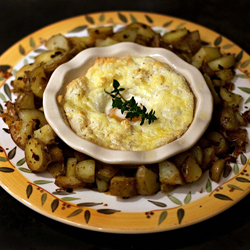 Failure may be too strong of a word.
In fact, I’m sure it is. On the other hand, saying “it tasted fine, but wasn’t really worth the effort” doesn’t make a very good headline. But it does neatly sum up this locavore household’s unanimous verdict on our Dark Days Challenge meal this week.
I’ve had Gourmet‘s recipe for Oeufs à la Cantalienne in my clippings for at least three years. The headnotes promise “the soft, yolky flavor of eggs Benedict but without all the hassle”, a notion that appealed to me as I tried to figure out a way to make midweek breakfast-for-dinner more exciting.
We’re pretty handy with eggs, but I think a novice cook especially might find this recipe — which entails buttering ramekins, separating eggs, keeping yolks intact, whipping egg whites, folding cheese, smoothing egg whites, and dolloping créme fraîche — at least as daunting as toasting muffins, poaching eggs, and whisking up a batch of Hollandaise.
When I went looking for other versions of this dish to see where I might have gone astray, I discovered that Molly – whose culinary opinion I trust — loved this recipe, and her photos of her friend Jimmy’s version look much more promising than ours did. I feel terrible casting aspersions based on a single lackluster effort, but on the other hand, this is not a recipe I’m anxious to try again. Faced with the same ingredients, next time out I’m just as likely to make a nice cheese-and-herb omelette to go with our home fries.
So here’s the recipe, in all of its glory. If you try it and like it (or even if you loathe it), I’d can’t wait to hear about it.

Oeufs à la Cantalienne (Baked Eggs with Cheese)
– adapted from Gourmet
Butter, for greasing ramekins
6 large eggs
1/4 tsp salt
1/4 tsp black pepper
1/8 tsp freshly grated nutmeg
1/8 tsp cream of tartar
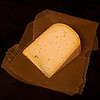
3 oz grated Cantal or other mild, semi-firm cow’s cheese (we used Carmody)
6 T créme fraîche
1 T chopped fresh herbs
Adjust oven rack to middle position and preheat oven to 350°F. Butter six 8-oz ramekins.
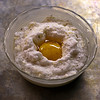
Separate the eggs, carefully sliding whole, unbroken yolks into a small bowl of cold water and putting whites in a large bowl. Add salt, pepper, nutmeg, and cream of tartar to the egg whites. Using an electric mixer at medium-high speed, beat whites with until they just hold stiff peaks.
Gently fold half of cheese into the beaten whites, taking care not to deflate the mixture, then divide among ramekins. Smooth the top of the egg whites, then make an indentation in the center of each ramekin.
Using your fingers, carefully remove yolks from water one at a time and put a yolk in each indentation. Stir créme fraîche, and dollop 1 tablespoon on top of each yolk; sprinkle eggs with remaining cheese. Transfer ramekins to a rimmed cookie sheet.
Bake until whites are puffed and pale golden but yolks still jiggle slightly, 10 to 14 minutes. Sprinkle with herbs and serve immediately.
Farmers and food artisans who created the ingredients for this week’s meal:
Spring Hill Cheese Company, Petaluma: butter
Soul Food Farm, Vacaville: eggs
Guisto’s Vita-Grain, South San Francisco: sea salt
Bellwether Farms, Sonoma: crème fraîche, Carmody cheese
Little Organic Farm, Marin: potatoes (for homefries)
Catalán Family Farm, Hollister: onion (for homefries)
…and our own homegrown thyme.
(Exemptions: black pepper, nutmeg, cream of tartar)
Dark Days challenge, locavore
2 Comments »
Posted by Anita on 01.18.10 6:23 AM
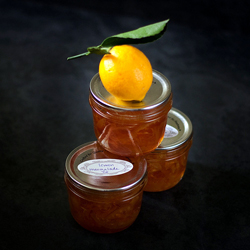 I don’t think anyone would be surprised to hear that I love to can. Most years, I get started on the preservation kick at the height cherry season (when I make my annual batch of cocktail garnishes), and don’t put away the canner until after the last tomato harvest. So when I heard about a new, year-round canning challenge — one that has participants putting up a different type of produce every month — I knew I had to jump on in and join Tigress’s Can Jam.
January’s Can Jam theme is citrus, a particularly apt topic here in the Bay Area where farmers markets and backyard trees are bursting with the best oranges, lemons, and grapefruits of the year. I always like canning with a friend to help share the work (and the resulting bounty), so I asked Laura from (not so) Urban Hennery if she’d like to can together when she visited San Francisco last weekend; she happily agreed. I flagged a bunch of citrus recipes in my favorite canning books, thinking I’d let Laura decide which sounded the most appealing. A girl after my own heart, she suggested that we make them all!
The first, a Meyer lemon curd, wasn’t technically eligible for the Can Jam, because it needs to be pressure canned to be shelf-stable. (The challenge requires all recipes to be suited to a standard boiling-water canner.) But we made it anyway, and oh am I glad we did. With the orange yolks from Laura’s hennery eggs — yes, she brought them down in her checked baggage! — and the deep yellow zest from Meyer lemons we bought from Hamada Farms, the end product turned an eye-searing yellow. If I saw a bottle of curd that yellow in the store, I’d walk away, thinking it must be filled with artificial everything.
Our second recipe — which used June Taylor‘s three-fruit marmalade as a starting point — featured a quadruple-dose of citrus: Moro blood oranges, lemons, golden grapefruit, and one giant bergamot from our backyard tree. We ended up with 9 half-pint jars of a deep crimson preserve, clear enough to see the different-shaped bits of peel suspended evenly throughout its jewel-like base. It’s pleasantly bitter, and (at least at this stage) you can pick out the flavor of each of the citrus varieties as you make your way through a spoonful… er, I mean, a slice of toast.
The last recipe turned out to be our hands-down favorite. Its simplicity — both of ingredients and of preparation — belies its gorgeous looks and uniquely delicious taste. Combining lemons, sugar, and water, this one’s good enough that Laura and I were already plotting how to get our hands on more Meyer lemons before the week was out.



Meyer Lemon Marmalade
– adapted from Catherine Plagemann’s Fine Preserving
3 perfect, very fresh Meyer lemons
1 more lemon, for juice
sugar (about 4 cups)
Sterilize canning jars and prepare lids according to manufacturer’s directions.
Peel the three lemons, removing just the yellow and none of the pith. Slice the peel into very fine, thin strips and set aside. Cut each peeled lemon in half, lengthwise. Remove as many seeds as possible plus the center strings. On a cutting board with a lip, slice the lemon halves, including the white rind, paper thin. Remove any remaining seeds. In a glass measure, combine the zest, lemon pulp, any juices from the pulp, and the juice of one more lemon. You should have about 1 cup of prepared lemon and juices.
Cover the prepared lemon with about a cup of cold water; it should be just enough to submerge all of the lemon. Let soak for 3 hours, to soften the zest. After soaking, combine the soaked lemon and zest in a wide Dutch oven along with an equal amount of sugar by volume. Bring to a simmer over medium-high heat, and simmer (do not boil) until the marmalade jells.
Keep a close eye on the cooking marmalade. It will go from liquid to jelled more quickly than you would expect. Don’t go by eye in the pan; the mixture will still look much more wet than a typically set marmalade. Use the saucer test or watch for the liquid to sheet off the edge of a metal spoon.
Ladle into hot, sterilized half-pint jars, leaving 1/4-inch headspace. Wipe rims of jars with a damp, clean towel; adjust canning lids and process in a boiling-water canner for 5 minutes. Turn off the heat and leave processed jars in the canner for 5 minutes more, then remove and cool on a thick towel or a wire rack for 12 hours. When jars are completely cooled, check for proper seal. Remove rings from sealed jars, and put any unsealed jars in the refrigerator to use first.
If you can bear it, it’s best to let this marmalade cure for at least a week before eating, otherwise the zest is a bit tough.
Yields three 8oz jars
CanJam, locavore, preserving & infusing, recipes
15 Comments »
