Posted by Anita and Cameron on 03.03.09 7:44 PM
Meeting a friend you’ve only known online can be a nervous affair. Will you get along? Will they be cool in person? What if they have a funny voice and a big nose? When the moment comes and they turn out to be even more fabulous than you’d hoped, the elation feels like a glassful of Champagne… or cava in this case.
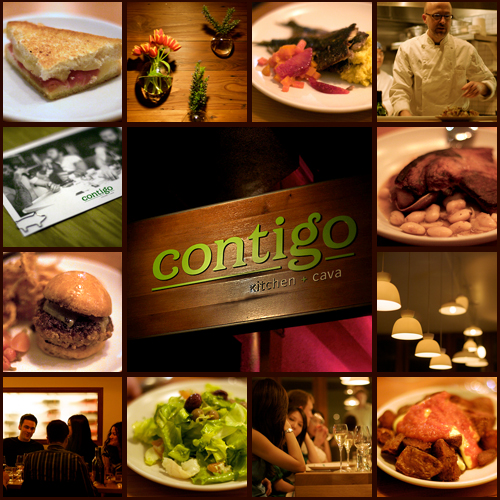
Elation was definitely the order of the evening Saturday night when we finally met Contigo, the new Spanish restaurant from our friend, Chef Brett Emerson. If you’re a fan of his blog, In Praise of Sardines, you’re probably familiar with the saga of Contigo’s opening, from the thrill of Brett’s snagging of a rare new-restaurant permit in Noe Valley, through the agony of multiple construction delays. I don’t know how Brett feels, but after tasting his food at a friends-and-family dinner before Contigo’s formal opening, I think all the drama was all worth it.
The space is beautiful, simultaneously contemporary and cozy. It’s not large, but it feels expansive thanks to five distinct dining zones — chef’s counter, lower dining room, cava bar, upper dining room, and a heated, covered outdoor patio surrounded by herb gardens.
Contigo’s ingredients are locally sourced, but not slavishly so — there’s jamón from Spain (and Iowa), alongside meat and vegetables from the usual assortment of local farms. And the food on the plate is every bit the equal of its gorgeous environment. We had a devil of a time deciding what to order; everything sounded appealing. Like an Iberian version of our favorite SPQR, Contigo offers an assortment of small pica-pica plates ($8 each, or $21 for three). Venerable tapas like crisp patatas bravas and marinated sardines take their place alongside an assortment of salads with Spanish twists. In the latter category, we loved the remojon: salt cod, oranges, and olives atop white radicchio.
We tried a couple of larger platillos as well. The juidones a la segovia were a dreamy assortment of delectable pork parts (belly, ears, yum!) atop creamy butter beans. The chorizo-y txistorra burger was fabulous, but be ready to share it with a friend; it’s too good to miss, but a little too rich to eat as an entree.
We weren’t sure how we managed to save room for dessert, but we were happy we did. We made short work of the not-too-sweet almond cake, filled with a dollop of pastry cream and a schmear of olallieberry preserves, a sweet nod to the restaurant’s history.
Contigo opens tonight, and there’s sure to be a line; reservations are accepted only for parties of 6 or more. But there’s a stand-up drink rail along the entryway, where you can enjoy a glass of cava and a nibble or two while watching the cooks work their magic in the beautiful open kitchen.
Contigo Kitchen + Cava
1320 Castro Street (x 24th Street)
San Francisco, CA 94114
415.285.0250
Noe Valley, other blogs, restaurants
9 Comments »


Posted by Anita and Cameron on 06.22.07 7:02 AM
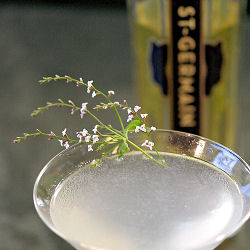 Let’s get one thing straight right off the bat: St-Germain, the new liqueur that’s sending ripples across the cocktail scene, comes in a bottle so beautiful that it will make you forget your budget, your better judgment, and most of your morals.
The producers call their elderflower-scented concoction “vie parisienne en bouteille” and from the look of things, they’re not far off. The shape is impressively soignée, in a luxe Art Nouveau style. The labels, too, are gorgeous — even the adhesive surface sports a gentle tapestry scroll, so as to please the eye when seen through the other side of the glass. Trés elegant.
According to an impossibly precious marketing backstory, hand-picked wild elderflowers are macerated and combined with eau de vie. The result is a liqueur that balances citrus and floral notes as gracefully as a skilled waiter carries a tray of cocktails. A heavy hand with the sugar is perhaps the liqueur’s only limitation; you need a steady resolve and a miser’s touch to make a drink that captures St-Germain’s floral notes without edging into tooth-aching sweetness.
Smart folks, these Germainistes: They’ve recruited many of the cocktail world’s leading lights to wax rhapsodic about their products, both around the web and in an adorable little booklet attached to every bottle. Alas, the recipes it contains are less successful, leaning toward the cloying and bizarre. Mon dieu! Drinks featuring green-apple vodka and pineapple juice — mercifully, not together — aren’t exactly consistent with the swanky image they’re painting with the rest of the brand messaging.
Left to our own devices, we successfully used a splash and a half of St-Germain to create impromptu Champagne cocktails. Meanwhile, we considered drinks that could benefit from the liqueur’s mysterious undertones without collapsing under the sugar’s weight.
We didn’t have to go far down our roster of possibilities to encounter a combination that puts this floral mixture in a flattering light. We started with a traditional Aviation, replacing the maraschino liqueur with St-Germain. The elderflower twines well with the lemon, but you may need to gently tinker with proportions to compensate for sweeter or more acidic fruit. Lime makes a pleasant alternative, should you be so disposed.
We christened our variation Le Bourget, in honor of the once-bucolic airfield where Lindbergh landed the Spirit of St. Louis after his landmark flight; nowadays it’s a bustling commuter hub and the home of the biannual Salon International de l’Aéronautique where — this very week — French aircraft manufacturers are touting their wares to potential clients. What better moniker for a French Aviation?




Le Bourget
2 oz gin
1/2 oz St-Germain elderflower liqueur
1/2 oz fresh lemon juice
Shake well with ice, and strain into a chilled cocktail glass.
Drink of the Week, drinks, recipes
7 Comments »
Posted by Anita and Cameron on 04.11.07 7:57 AM
 We haven’t been writing a lot of restaurant reviews lately, mostly because life has kept us from eating anywhere new or noteworthy. We’ve also both come to the conclusion (separately, we might add) that writing a negative review, or even a so-so one, is exhausting. You feel the need to justify every criticism, and defend every quibble. And, really, who wants to read our bitchy moaning, especially when it comes to a place that so many other foodies adore?
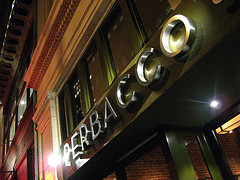
But a number of people have noticed our Perbacco shots on Flickr, and asked when we were going to post, so it’s getting to be more work ducking the question than it is to just… come out with it.
Let’s start out by saying we had high hopes for Perbacco. Not unrealistic ones, we hope, but strong expectations buoyed by heaps of affirmative press plus an early report that the chef, a former butcher, spends his weekends curing his own salumi. Truly, a man after our own hearts.
Our initial visit left us disappointed but convinced that the food was worthy if you steered clear of so-so main courses in favor of pastas. We both decided that it was only the colossally amateurish service that prevented us from having the sort of night that we’d gush about. But after a second visit yielded significantly better service but much worse food, we just can’t join the chorus of adulation being sung in Perbacco’s key.
To start with a positive note, the salumi options improved between our first and second visits. Our first time around, the starter menu offered only a single house-cured sausage plate and a large sampler platter, which forced a frustrating choice between a one-note (and, dare we say, stingy?) sampling and an appetite-spoiling array. On our second visit, we were happy to see some more-interesting options: both greater variety and a selection of smaller assortments, each with a different stylistic focus.
But uneven notions of scale and surfeit extend beyond the salumi at Perbacco. All through both meals, the theme continued: Too much, not enough, too much, not enough… like some practical joke played by the kitchen at our expense.
First: Overkill. On our initial visit, Anita loved the taste of her burrata appetizer, but quickly tired of its unctuous, truffled intensity. Cameron’s strongly flavored salad was another tastebud-killer: All the components hung together well, but by the time he was halfway through, the richness of chestnut honey, gorgonzola, and hazelnuts exhausted his palate. On our return trip, Anita’s beet-and-arugula salad offered just too much of the same flavors, over and over, without relief.
Next: Underflavored. Although the feta-like Castelmagno cheese on Anita’s beet-and-arugula salad provided more of a salty kick than was pleasant, the beets themselves were flat and nearly flavorless. On our second visit, Anita’s pasta didn’t appear to have any salt in the dough, and had been dressed with unsalted butter. A cauliflower passata presented a perfect, velvety texture, but didn’t actually taste like its sponsor vegetable — a cauliflower soup for people who dislike cauliflower.
We always feel sorry for chefs who present a traditional Italian three-course menu of appetizers, pastas, and mains. We Americans are so attuned to the pasta-centric dinners we grew up on that it seems almost futile for chefs to run the antipasti-primi-secondi route. We do our best to support the traditional flow when our appetite allows, but the too-variable portion sizes at Perbacco made this an exercise in futility.
We loved the tajarin (hand-cut tagliatelle) with pork-and-porcini sugo as a middle course on our first visit, but an entrée portion that we ordered on our second visit was only a smidge larger — nowhere near sufficient to serve as a main course. Likewise, the sides accompanying all three of the main courses we ordered (two the first visit, one the second) were so skimpy that you wished the chef would just offer his entrees a la carte and be done with it.
And frankly, Perbacco’s entrees are its weakest link. Anita loves milk-braised pork and she’s ga-ga for grits, so Perbacco’s pork shoulder al latte with whole-grain Anson Mills polenta and shredded Savoy cabbage seemed like a shoo-in. But the unappetizingly symmetrical chunk of pig — plated like Lean Cuisine on a small oval dish — lacked the cut-it-with-a-fork tenderness that’s the hallmark this traditionally braised dish. And again, the sides were laughably meager, a criminal offense given their peasant-like affordability. (Could there be anything cheaper than corn mush and cabbage? Why such tiny nibbles?)
Both times we opted for a trio of gelati for dessert. Presented in adorable ceramic dishes made to look like partially crushed Dixie cups, the flavors ran the gamut from delightful (a fleur de sel caramel that tasted identical to a version we made last year) to unpleasant (an overwhelming pistachio).
Sadly, we doubt we’ll take another stab at dinner at Perbacco. We can envision returning for a plate of salumi at the bar, alongside one of their well-made cocktails… especially the Rosmarino. And certainly, if friends suggested we meet at Perbacco, we wouldn’t decline. But for the price — dinner both times hovered near the $200 mark for a full complement of food but minus any blow-out wines or other additions — we can’t afford the gamble of another hit-and-miss meal.
Perbacco
230 California Street (near Front Street)
San Francisco, CA 94111
415.955.0663
downtown SF, Italian, restaurants
3 Comments »
Posted by Anita and Cameron on 01.23.07 7:42 AM
 Over at The Cocktail Chronicles, Paul’s announced the next three month’s worth of Mixology Monday themes:
February 12: Whisk(e)y, hosted by Jimmy’s Cocktail Hour.
March 12: Shots, hosted by Martini Lounge.
April 16: Champagne cocktails, hosted by us.
We’re looking forward to it — cheers!
drinks, Mixology Monday, other blogs, wine & bubbly
1 Comment »
Posted by Anita and Cameron on 01.17.07 7:57 AM
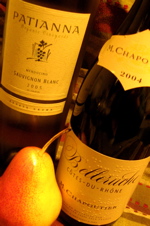 Always up for a challenge — and excuses to try new wines — we joined this month’s Wine Blogging Wednesday, focusing on biodynamic wines. I thought we might have a difficult time sourcing an appropriate bottle, so I was pleasantly surprised when the wine merchant at Plumpjack Wines in Noe Valley identified a dozen or more biodynamic wines for us, and another 20 or more bottles that were being produced using biodynamic principles, or by wineries that are in the process of converting to biodynamics.
Unfortunately, I couldn’t find any indication that the wine we ultimately chose from his options — a white from Domaine Tempier, the producers of our favorite rosé — was created biodynamically. According to information on a number of sites, Tempier is indeed a venerable (albeit uncertified) organic winery, but they only occasionally dabble in biodynamics… and one can surmise that their low-end $12 Bandol Blanc probably isn’t the wine they’re dabbling with. (I’m glad we’ll get to try it… but I’m cranky that it was misidentified.)
So, over to BevMo, this time with Fork & Bottle’s list of biodynamic producers in hand. Trust, as they say, but verify.
 Our tasting notes:
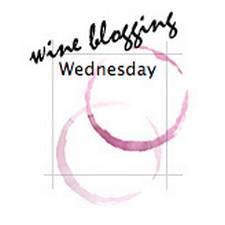
Patianna Sauvignon Blanc ’05 Mendocino (California) – $14.99 ($18 winemaker’s list)
80% Sauvignon Blanc clone #1, 20% Sauvignon Musque
Pale champagne color; yeasty on the nose; watery and thin flavors, but with an incredibly long finish (with no unpleasant aftertaste); the merest hint of effervescence. Cameron felt the wine had a toasty nose, and found hints of shellfish and sour in the corners. Anita missed the classic dry melon/pear flavors she loves in Sauv Blanc — in fact, there was little fruit at all. It was hard to believe that this was a New World wine. Compared to the similarly priced Chateau Souverain Alexander Valley Sauvignon Blanc (our “house” white), we agree that the Patianna winds up sour and unbalanced.
Chapoutier Cotes du Rhone Belleruche ’04 – $16.99 (€5.09 winemaker’s list)
80% Grenache, 20% Syrah
Straight out of the bottle and then in the glass, there’s a whiff of caramel nose, which doesn’t last, followed by a faint cherry nose and not much else, even when fully (over)warmed. Clear, medium-ruby colored. A lot of mineral tang at first, and though the wine eventually opened up, it never went far enough for us to really enjoy. Better with food than alone, not surprisingly. Fairly astringent for a 2-year-old wine. Thin, not a lot of complexity — it tastes like dried cherries and not a lot else. Trés French and not unpleasant, but seems over-simple and uninteresting compared to our usual array of $8-12 Cotes du Rhone options. Cameron would buy it again for something uncomplicated to drink in the summer…if we could get it for five Euros. Anita would use her seven bucks to try something else.
other blogs, shopping, wine & bubbly
6 Comments »
